Chery South Africa production 2027
Chery Confirms Three Local Models
PRETORIA, 20 October 2026 — Chinese automotive giant Chery has confirmed three vehicles that will be manufactured at its Rosslyn production facility in South Africa, marking another step in the company’s expansion into the country’s automotive manufacturing industry.
The announcement was made during Chery’s international user summit in Wuhu, China, where Chery South Africa chief executive Tony Liu outlined the manufacturer’s latest production plans.
The three vehicles are the Omoda C4 crossover, the Chery Grootman double-cab bakkie and the Jetour T2 SUV.
Local production is scheduled to begin in 2027, with the Omoda C4 expected to lead the newly announced rollout during the third quarter.
The Grootman and Jetour T2 will follow as Chery expands production at the former Nissan manufacturing facility.
The investment forms part of the company’s strategy to establish a stronger manufacturing presence in South Africa while serving domestic and potentially wider African markets.
Three Vehicles Confirmed For Production
Chery’s latest announcement identifies three vehicles that will form part of its Rosslyn manufacturing programme.
| Model | Vehicle category | Production plans |
|---|---|---|
| Omoda C4 | Compact crossover SUV | Scheduled to begin in Q3 2027 |
| Chery Grootman | Double-cab bakkie | To follow the Omoda C4 |
| Jetour T2 | Adventure-oriented SUV | To follow the Omoda C4 |
The announcement provides further clarity about the company’s plans for the plant.
Other vehicles, including the Chery Tiggo 4 Cross and Jaecoo J5, have previously been identified for local production.
The latest three-model announcement should therefore not be interpreted as the complete list of vehicles planned for Rosslyn.
Omoda C4 To Lead Production
The Omoda C4 is expected to be the first vehicle in the newly announced production sequence.
According to Liu, manufacturing is planned to begin at the start of the third quarter of 2027.
The C4 will occupy a position below the Omoda C5 in the brand’s South African lineup.
It will compete in the compact crossover segment, where affordability, technology and fuel efficiency are important considerations for buyers.
The vehicle was previously unveiled internationally under the C3 name before being renamed C4 for South Africa.
Its dimensions place it among compact family crossovers, with a reported length of approximately 4,424mm.
Chery has indicated that a hybrid version will be part of the initial local manufacturing plan.
Petrol and battery-electric versions are also planned, although their precise local production schedules have not been confirmed.
The model is expected to launch in South Africa as an imported vehicle before local assembly begins.
Why The Omoda C4 Matters
Compact SUVs have become increasingly important in South Africa’s passenger vehicle market.
Buyers are attracted to their higher driving positions, practical interiors and relatively accessible prices compared with larger SUVs.
Chery has already experienced strong demand for vehicles in this segment through its Tiggo range.
Producing the Omoda C4 locally could support the company’s efforts to expand its market share and improve supply flexibility.
However, the company has not confirmed whether local manufacturing will result in lower retail prices.
Final pricing will depend on production costs, component sourcing, exchange rates and other commercial factors.
Chery Grootman Bakkie Coming To South Africa
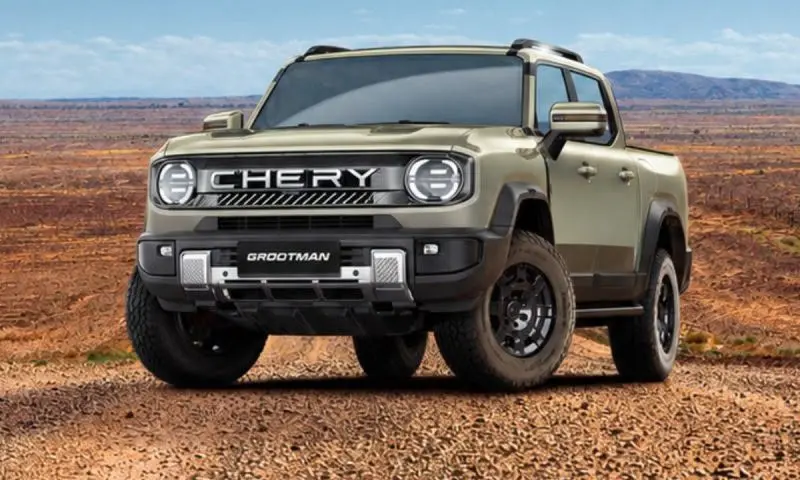
The second vehicle in the announcement is the Chery Grootman, a new double-cab bakkie developed for markets including South Africa.
The Grootman name was selected with input from South African consumers.
In other international markets, the vehicle is expected to use the Stockman name.
The bakkie represents Chery’s attempt to enter one of South Africa’s most competitive vehicle segments.
Established competitors include the Toyota Hilux, Ford Ranger, Isuzu D-Max and GWM P-Series.
Chery has indicated that the Grootman will launch locally during the first quarter of 2027.
Initial units are expected to be imported before manufacturing shifts to Rosslyn later in the year.
Grootman Expected To Offer Hybrid Technology
Chery has previewed hybrid technology for its upcoming bakkie programme.
The KP31 concept, which forms part of the manufacturer’s broader pickup development strategy, features a diesel-hybrid powertrain.
However, the final South African Grootman engine lineup, specifications and retail prices have not yet been fully confirmed.
The vehicle’s success will depend on factors including towing capability, payload, durability, fuel consumption and after-sales support.
These considerations are particularly important in South Africa, where double-cab bakkies are used for both private transport and commercial activities.
Local manufacturing could also create opportunities for component suppliers and businesses supporting the automotive industry.
Jetour T2 Joins Local Manufacturing Plans
The third confirmed model is the Jetour T2.
The SUV has attracted attention in South Africa through its rugged styling and adventure-oriented design.
Jetour operates as a distinct automotive brand in the local market but forms part of the wider Chery automotive group.
The T2 competes in a segment aimed at motorists seeking larger SUVs with practical family and recreational capabilities.
According to the Mail & Guardian’s report from Chery’s international summit, the Jetour T2 has recorded sales approaching 5,000 units in South Africa.
The model was also named the 2026 South African Car of the Year.
Its inclusion in the Rosslyn manufacturing programme indicates that Chery intends to use the facility for vehicles across multiple brands and market segments.
Jetour has previously indicated that its T1 and T2 models are part of its South African localisation plans.
Former Nissan Factory Gets New Life
Chery’s production expansion follows its acquisition of Nissan’s manufacturing facility in Rosslyn, northwest of Pretoria.
The plant has a long history in South Africa’s automotive industry.
Nissan previously manufactured vehicles at the site, including the Navara bakkie.
Chery officially inaugurated the facility in July 2026, signalling its transition from relying on imported vehicles to establishing local manufacturing operations.
The acquisition included existing industrial infrastructure and manufacturing assets.
Using an established automotive facility gives Chery access to production infrastructure and a workforce with relevant experience.
However, the plant still requires upgrades and preparations to accommodate the manufacturer’s new vehicle programmes.
Chery Retains 692 Employees
One of the most significant developments is Chery’s confirmation that it has retained 692 employees from the former Nissan operation.
Liu said the workers are undergoing training ahead of the commencement of production.
Some employees have already travelled to China for training at Chery facilities.
The initial training programme includes management personnel, with additional groups expected to follow.
The retention of experienced automotive workers could help preserve manufacturing skills within South Africa.
It also provides Chery with employees familiar with vehicle production processes and the Rosslyn industrial environment.
The company has previously indicated that its investment could support nearly 3,000 direct and indirect jobs across manufacturing and the broader supply chain.
That figure represents a projected employment impact, rather than 3,000 newly confirmed appointments.
Factory Targets 50,000 Vehicles Annually
Chery has outlined plans to increase production gradually as the Rosslyn operation becomes established.
The initial ramp-up programme targets approximately 15,000 vehicles during the second half of 2027.
That would represent an average of 2,500 vehicles per month over six months.
The company has also identified an eventual annual production capacity target of 50,000 vehicles.
These figures are production targets and should not be interpreted as completed output.
Actual volumes will depend on plant readiness, supplier capacity, customer demand and the manufacturer’s production schedule.
Chery has also indicated that it wants to increase the use of locally sourced vehicle components.
Its initial localisation ambitions include a target of approximately 40% local content.
If achieved, this could provide opportunities for South African manufacturers supplying automotive components and related services.
Tiggo 4 Cross And Jaecoo J5 Also Planned
Although the latest announcement focuses on the Omoda C4, Grootman and Jetour T2, Chery has previously confirmed additional models for Rosslyn.
In July, the company announced that the Tiggo 4 Cross would be among the first vehicles produced locally.
Both petrol and hybrid versions were included in those plans.
The Tiggo 4 range has performed strongly in the South African market.
Chery reported combined sales of 11,322 units for the Tiggo 4 Pro and Tiggo Cross during the first six months of 2026.
The Jaecoo J5 has also been confirmed for local production, including conventional petrol and new-energy vehicle derivatives.
The broader model programme suggests that Chery intends to establish Rosslyn as a manufacturing centre serving several brands within its automotive group.
The precise order and timing of all planned model launches may still change as the factory’s rollout progresses.
What Local Production Means For South Africa
Chery’s manufacturing plans arrive at a time when South Africa is seeking to protect and expand its automotive production industry.
Vehicle manufacturing is an important contributor to industrial activity, exports and employment.
Local production can support demand for components, transport services, engineering businesses and specialised technical skills.
It can also encourage investment in supplier facilities and related infrastructure.
For consumers, local manufacturing may improve the availability of certain models and reduce dependence on fully imported vehicles.
However, locally assembled vehicles are not automatically cheaper than imports.
Retail prices depend on several factors, including component costs, production volumes, taxes and distribution arrangements.
The economic benefits will also depend on how much of each vehicle’s value is generated through South African suppliers and workers.
Chinese Automakers Expand Their Presence
Chinese automotive manufacturers have increased their presence in South Africa in recent years.
Brands including Chery, GWM, BYD, Omoda, Jaecoo and Jetour have introduced vehicles across multiple price categories.
Their growing presence has increased competition in the passenger vehicle and SUV markets.
Chery’s move into local production represents a further development because it involves investment in manufacturing rather than relying entirely on imports.
The strategy could also position the company to explore exports to neighbouring African markets.
However, any future export programme would depend on commercial agreements, regional demand and applicable trade requirements.
When Will South Africans See The New Vehicles?
The latest production announcement identifies the third quarter of 2027 as the starting point for the Omoda C4 manufacturing programme.
The Grootman and Jetour T2 are expected to follow.
Some vehicles may become available to South African buyers as imports before locally assembled versions reach dealerships.
Chery has not yet announced a complete production timetable covering every model planned for the Rosslyn facility.
It has also not confirmed final prices for the upcoming Omoda C4 and Grootman.
Those details are expected to become clearer closer to their respective market launches.
A Major Step For Rosslyn Manufacturing
Chery’s decision to manufacture the Omoda C4, Grootman and Jetour T2 in South Africa represents a significant expansion of its local industrial ambitions.
The company’s investment provides a new future for the former Nissan plant and preserves hundreds of existing manufacturing jobs.
Its plans also create opportunities for additional training, local procurement and automotive supply-chain development.
The next major milestone will be the successful commissioning of the production lines and the rollout of locally assembled vehicles during 2027.
For South African motorists, the development means that more vehicles from Chery’s growing brand portfolio could eventually carry a locally assembled designation.