
Ramaphosa Votes at Hyde Park as Joburg Voters Demand Change
Johannesburg Voters Demand Better Services as Ramaphosa Casts His Vote at Hyde Park High School
JOHANNESBURG, 4 November 2026 — Johannesburg residents arrived at Hyde Park High School on Wednesday morning to participate in South Africa’s 2026 local government elections, with voters expressing hopes for improved service delivery, accountable leadership and meaningful change in their communities.
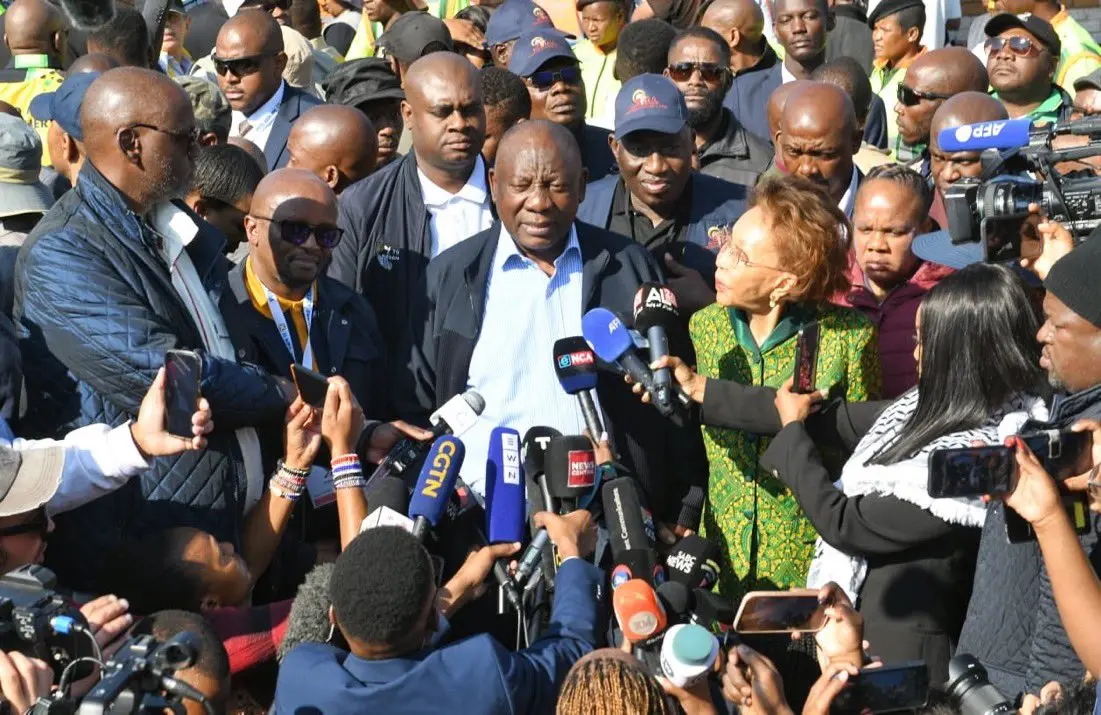
The voting station attracted national attention as President Cyril Ramaphosa and First Lady Dr Tshepo Motsepe arrived to cast their ballots.
The Presidency had scheduled the president’s vote for 10am, and subsequent reporting confirmed that both Ramaphosa and Motsepe had voted.
For ordinary residents, however, the focus was not only on the president’s appearance but also on the future of Johannesburg and the quality of municipal services.
Voters Arrive at Hyde Park High School
Voting began at 7am across South Africa as millions of registered voters were given the opportunity to elect representatives to their municipal councils.
At Hyde Park High School, residents arrived to participate in the democratic process.
Some expressed satisfaction with the organisation of the voting station, while others spoke about their expectations for the next municipal administration.
Johannesburg resident David Rozen told the Mail & Guardian that electoral officials were helpful and that the voting process was running efficiently.
Rozen, who grew up in Johannesburg, reflected on the changes he had witnessed in the city over the years.
He said he hoped the election would bring improvements to Johannesburg and encouraged public participation in the democratic process.
His comments reflected a broader theme among voters interviewed at the station: a desire for municipal leadership that responds to the needs of communities.
Mother Brings Daughter to Learn About Democracy
Another voter, Lindiwe Tshabalala, brought her young daughter to the voting station to help her understand the importance of democratic participation.
Tshabalala explained that her daughter was still approximately a decade away from being eligible to vote.
Nevertheless, she believed it was important for the next generation to understand the right to participate in elections.
She reflected on the experiences of older South Africans who had been denied equal voting rights under apartheid.
Her father, who died in 2005, had only been able to participate in a limited number of democratic elections during his lifetime.
For Tshabalala, voting represented more than choosing a political party.
It was also an opportunity to teach her daughter about citizenship, democratic rights and the responsibility of elected representatives.
Water, Electricity and Housing Among Voters’ Concerns
Tshabalala also highlighted the importance of reliable basic services.
She expressed hope that elected leaders would address water shortages, electricity problems, housing needs and crime.
These issues have become central to discussions about local government performance in Johannesburg.
Communities across the city have experienced recurring disruptions to essential municipal services.
Water supply problems have been particularly prominent in the weeks leading up to the elections.
Residents in several neighbourhoods have reported prolonged interruptions, low pressure and uncertainty about restoration times.
The city’s next administration will face pressure to improve infrastructure maintenance, strengthen municipal finances and restore public confidence in service delivery.
Ramaphosa and First Lady Cast Their Votes
President Cyril Ramaphosa and First Lady Dr Tshepo Motsepe cast their votes at Hyde Park High School on Wednesday.
The Presidency had confirmed the arrangement on Tuesday, announcing that the couple would vote at the Johannesburg school at 10am.
After voting, Ramaphosa spoke to journalists about the significance of election day.
He described himself as confident and in good spirits, presenting the election as an important occasion for South Africans and his party, the African National Congress.
His remarks came as the ANC faced a significant electoral test in major metropolitan municipalities.
The president had previously called on registered voters to participate in the elections and exercise their democratic rights.
Ramaphosa Changes His Traditional Voting Station
This year’s election also marked a change in Ramaphosa’s voting arrangements.
In previous elections, the president had regularly voted at Hitekani Primary School in Chiawelo, Soweto.
He cast ballots there during the 2019 and 2024 national elections and the 2021 local government elections.
For the 2026 local elections, he voted at Hyde Park High School instead.
The change attracted attention because of his long-standing connection to Soweto.
The Presidency confirmed the new voting venue but did not provide a detailed public explanation for the change.
Why the 2026 Local Elections Matter
South Africa’s local government elections determine who will represent communities in municipal councils for the next five-year term.
Municipalities are responsible for services that directly affect residents’ daily lives.
These include water distribution, electricity services in municipal supply areas, waste collection, local roads and municipal planning.
Johannesburg’s election is particularly significant because the city has experienced several changes in political leadership and coalition arrangements.
No single political party has consistently maintained an outright governing majority in recent years.
The composition of the newly elected council will determine whether a party can govern independently or must negotiate a coalition arrangement.
Johannesburg’s Political Leaders Cast Their Votes
Other prominent political figures also voted on Wednesday.
Democratic Alliance Johannesburg mayoral candidate Helen Zille cast her ballot at Emmarentia Primary School in Randburg.
Zille said Johannesburg’s water crisis would be a priority if she became mayor.
ActionSA leader and Johannesburg mayoral candidate Herman Mashaba voted in Sandton.
Mashaba spoke about his party’s engagement with communities and expressed confidence in its campaign.
Build One South Africa leader Mmusi Maimane voted in Dobsonville, where he highlighted the need for improved water services, employment opportunities and economic growth.
Their statements reflected different campaign priorities and political perspectives.
The election results, rather than campaign declarations, will determine the parties’ representation in council.
More Than 29 Million Registered Voters
More than 29 million South Africans were registered to participate in the 2026 local government elections.
The Electoral Commission of South Africa prepared more than 23,000 voting stations nationwide.
Voting stations opened at 7am and were scheduled to close at 9pm on Wednesday.
The election followed two days of special voting on Monday and Tuesday.
Special voting arrangements allowed approved voters to cast their ballots ahead of election day, including through home visits for eligible voters unable to travel to voting stations.
The IEC has urged voters to follow electoral procedures and respect the rights of others participating in the election.
What Voters Need to Know
Registered voters must vote at their designated voting stations.
Acceptable identification includes a South African smart ID card, green barcoded identity book or valid temporary identity certificate.
Voters can confirm their registration details and voting stations through the IEC’s official communication channels.
The commission has also reminded political parties and supporters to avoid intimidation, interference with election materials and conduct that disrupts voting.
The secrecy of the ballot remains a central principle of the electoral process.
Johannesburg Awaits Its Next Municipal Council
Once voting concludes, the IEC will begin finalising the counting and verification of ballots.
The official results will determine how Johannesburg’s 270 council seats are distributed among political parties and ward representatives.
The newly constituted council will then elect the city’s executive mayor.
Where no party holds a majority, coalition negotiations may be required to establish a governing administration.
The next municipal leadership will inherit substantial challenges involving infrastructure, water supply, electricity, waste management and financial sustainability.
For voters at Hyde Park High School, Wednesday’s election offered an opportunity to participate in choosing the representatives responsible for addressing those issues.
The message emerging from residents was that democratic participation must be followed by improvements in the everyday services communities depend on.
As President Ramaphosa and thousands of other South Africans cast their ballots, attention now turns to the election results and the municipal administrations that will follow.
Ubuntu9Media will continue covering the 2026 local government elections, Johannesburg’s council results and developments in coalition negotiations.

Pingback: Ramaphosa Confident ANC Will Win Local Elections 2026 - Ubuntu99Media