March and March court interdict
SAPS Moves to Stop March and March Amid Arson Fears
DURBAN, 29 October 2026 — The South African Police Service (SAPS) has approached the KwaZulu-Natal High Court in Durban in an urgent legal effort to prevent further violence and property destruction linked to demonstrations organised by the March and March movement.
The application follows police intelligence alleging that the Department of Home Affairs Refugee Reception Centre on Che Guevara Road, formerly Moore Road, in Berea could be targeted in an arson attack.
Acting Police Minister Firoz Cachalia and KwaZulu-Natal police commissioner Lieutenant-General Nhlanhla Mkhwanazi are seeking court intervention against the movement, its leadership and several other respondents.
An interim interdict has reportedly been granted, with the matter scheduled to return to court on Friday, 30 October 2026.
The police application seeks to prevent unlawful demonstrations, intimidation, assaults, forced business closures and attacks on property.
However, the allegations concerning a planned arson attack have not been established as findings of fact by a court.
Police Turn to Court Over Alleged Arson Threat
According to court documents reported by several news organisations, police received intelligence suggesting that the refugee reception centre in Berea could be attacked.
The centre provides immigration-related services, including services connected to asylum applications.
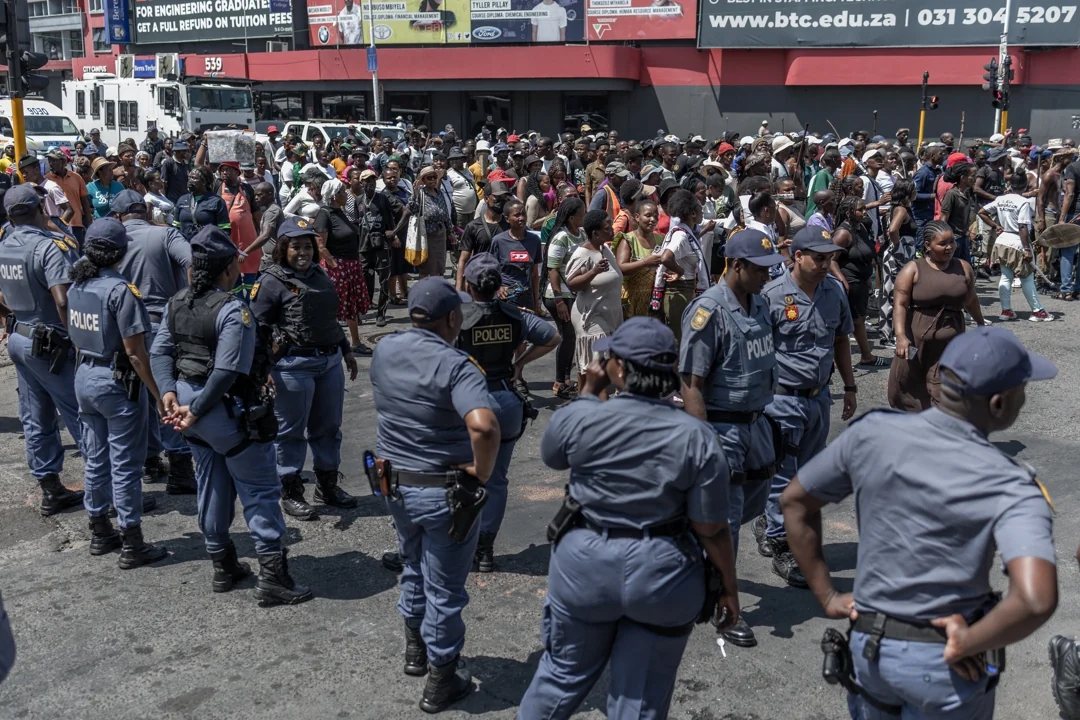
Police say the alleged threat must be considered against the backdrop of recent unrest in Durban, where anti-immigration demonstrations have been accompanied by reports of intimidation, road blockades and damage to property.
In the founding affidavit, Brigadier Thamsanqa Gama described the situation as presenting an immediate danger to public safety.
Authorities argue that urgent court intervention is necessary to prevent further violence rather than waiting for additional incidents to occur.
The application seeks restrictions on conduct that police believe could endanger residents, traders, motorists, government employees and foreign nationals.
Cachalia and Mkhwanazi Lead Legal Action
The urgent application identifies the Minister of Police as the first applicant and the KwaZulu-Natal provincial police commissioner as the second applicant.
March and March is named as the first respondent.
Its leader, Jacinta Ngobese-Zuma, is also named, alongside other individuals identified in the court papers.
Additional respondents include the eThekwini Municipality, the head of the metropolitan police service and the Minister of Home Affairs.
The application was filed under case number 2026-266812.
Police are asking the court to restrict specified protest activities across the eThekwini municipal area, with particular attention to Durban’s central business district and the Home Affairs facility in Berea.
The matter is scheduled to be heard on Friday at 10am.
What Police Want the Court to Prohibit
The requested order extends beyond a prohibition on setting fires.
According to the reported notice of motion, police want the respondents restrained from organising or participating in specified marches, protest convoys and encampments in the affected areas.
The application also seeks to prohibit threatening or assaulting residents, business owners, employees and public officials.
Other conduct identified includes looting, damaging buildings and vehicles, forcing businesses to close and obstructing entrances to public or private premises.
The police have specifically requested protection for the refugee reception centre.
These are requests made by the applicants. Their final legal effect depends on the terms of the court’s orders.
Interim Interdict Reportedly Granted
While the main urgent application is scheduled for Friday, eNCA has reported that an interim interdict has already been secured.
An interim interdict is a temporary court order intended to provide protection while the court considers whether longer-lasting restrictions should be imposed.
It does not automatically mean that every allegation made by the applicants has been proven.
The respondents are expected to have an opportunity to challenge the application.
Friday’s proceedings will therefore be important in determining whether the restrictions should continue and what their final scope should be.
March and March Responds to Court Action
March and March leader Jacinta Ngobese-Zuma has publicly criticised the government’s response to the demonstrations.
In a social media statement reported by the Daily News, she accused authorities of deploying extensive policing resources against protesters while failing to provide comparable protection to communities affected by illegal mining.
She also confirmed that the movement intended to attend Friday’s court proceedings.
Her response reflects the movement’s argument that government should devote greater attention to crime, immigration enforcement and the economic concerns raised by its supporters.
However, those grievances are separate from the allegations of threatened violence that form part of the police application.
The movement has not been found guilty of planning an arson attack merely because police have sought an interdict.
Movement Demands Action on Jobs and Immigration
The legal confrontation follows demonstrations during which March and March called for stronger immigration enforcement and greater economic opportunities for South African citizens.
On 27 October, the movement submitted a memorandum to Berea police.
The document addressed employment practices, regulation of e-hailing and delivery services, support for local businesses, policing and immigration administration.
It also called for investigations into alleged corruption and unlawful employment practices.
These demands form part of a broader debate about unemployment, immigration enforcement and access to economic opportunities.
However, allegations of unlawful employment or immigration violations must be investigated through lawful procedures.
Individuals cannot be presumed to be undocumented or involved in criminal activity because of their nationality or appearance.
Recent Violence Raises Security Concerns
The court application comes after reports of violent incidents associated with anti-immigration demonstrations in Durban.
Authorities have cited damage to property, forced business closures and attacks on individuals.
Police also reported that a foreign national was beaten to death by a group during a march in the city centre.
The circumstances and individual responsibility for that death remain matters for criminal investigation and, where applicable, prosecution.
The reported incidents have increased concerns about further confrontations between demonstrators, residents, business owners and law enforcement officials.
Police argue that the risk of renewed violence justifies urgent preventative measures.
Soldiers Deployed to Support Police
The security situation has also prompted a military response.
According to Associated Press reporting, President Cyril Ramaphosa authorised the deployment of 510 soldiers to KwaZulu-Natal following unrest linked to anti-immigration protests.
The deployment forms part of Operation Prosper, under which the South African National Defence Force supports police operations.
The reported deployment is scheduled to continue through November, at an estimated cost of R34 million.
The soldiers are intended to assist law enforcement rather than replace ordinary policing functions.
Their deployment underscores the seriousness with which national authorities are treating the risk of further unrest.
Constitutional Right to Protest Remains Central
South Africa’s Constitution protects the right to assemble, demonstrate, picket and present petitions peacefully and unarmed.
That right applies to people expressing concerns about immigration, unemployment, policing and government policy.
However, constitutional protection does not extend to arson, assault, looting or intimidation.
The courts must consider whether restrictions sought by police are lawful, justified and appropriately limited.
An order targeting unlawful conduct is not necessarily equivalent to a blanket prohibition on peaceful protest.
The distinction will be important when the High Court considers the scope of the requested interdict.
Why the Refugee Reception Centre Matters
The Home Affairs Refugee Reception Centre provides services to people seeking protection under South Africa’s refugee and asylum laws.
Disruptions to its operations can affect applicants, employees and members of the public.
An attack on the building could also threaten neighbouring businesses and residents.
Police have therefore placed particular emphasis on preventing interference with access to the premises.
The alleged threat to the centre remains an allegation contained in the legal proceedings, not proof that the movement or any named respondent planned an attack.
What Happens in Court on Friday?
The Durban High Court is expected to consider whether the interim restrictions should be maintained or confirmed.
The police applicants will seek to justify the urgency and scope of the relief requested.
March and March and the other respondents may challenge the allegations and the proposed restrictions.
The court may consider the evidence of threatened violence, previous incidents and the constitutional rights of those affected.
The outcome could determine how future demonstrations by the movement are conducted in Durban.
It may also clarify the responsibilities of police and municipal authorities when responding to protests that present potential public-safety risks.
Public Safety and Protest Rights Under Scrutiny
The dispute places two important public interests before the court.
On one side is the constitutional right to peaceful protest and the ability of communities to raise grievances about government policy.
On the other is the responsibility of law enforcement to protect people, businesses and public facilities from violence.
Police say urgent intervention is necessary to prevent further harm.
March and March has challenged the government’s handling of its protests and confirmed its intention to appear in court.
The central question now is whether the evidence justifies the restrictions sought by SAPS and how those restrictions can be applied without unnecessarily limiting lawful demonstrations.
The Durban High Court’s proceedings on 30 October will be the next significant development.