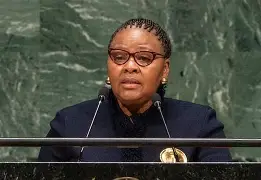
Mapisa-Nqakula Witness Testimony Gaps
Mapisa-Nqakula’s lawyers point out apparent inconsistencies in witnesses’ testimonies
PRETORIA – The defence team representing former National Assembly Speaker Nosiviwe Mapisa-Nqakula has highlighted what it says are inconsistencies between the evidence of key witnesses in her corruption trial, challenging the credibility of the State’s case against her. Mapisa-Nqakula Witness Memory Lapse
The defence’s cross-examination has focused on differences between the testimony of defence contractor Nombasa Ntsondwa-Ndhlovu and information previously provided by Deputy Defence Minister Bantu Holomisa, the main complainant in the case.
Mapisa-Nqakula faces 12 counts of corruption and one count of money laundering, with the State alleging that she solicited about R4.5 million and received approximately R2.1 million in cash from Ntsondwa-Ndhlovu while serving as defence minister.
Defence focuses on conflicting versions
One of the central issues raised by Mapisa-Nqakula’s lawyer, Siyabulela Mapoma, concerns the amount of money allegedly discussed in a letter Holomisa sent to Parliament.
According to the defence, Holomisa referred to an alleged R200,000 bribe in his letter.
However, that amount was not mentioned by Ntsondwa-Ndhlovu in her testimony before the Gauteng High Court in Pretoria.
Mapoma questioned the discrepancy, arguing that the two versions could not both be accurate. Eyewitness News reported that the defence lawyer suggested that one of the two witnesses must be lying.
The issue is significant because Holomisa’s knowledge of the alleged payments is connected to the prosecution’s account of how the allegations came to light.
Why Holomisa’s evidence matters
Ntsondwa-Ndhlovu is the State’s key witness and the sole director of Umkhombe Marine, a company that secured contracts from the Department of Defence.
She alleges that Mapisa-Nqakula solicited and received money from her during the period in which she was defence minister.
Holomisa became involved after Ntsondwa-Ndhlovu allegedly confided in him about the payments.
This makes the relationship between the accounts of the two witnesses an important area for the defence to explore.
The alleged R2 million request
The defence also questioned why Ntsondwa-Ndhlovu did not tell Holomisa about another allegation she later raised in court.
The witness testified that Mapisa-Nqakula allegedly solicited R2 million to secure a promotion for her husband, senior military doctor Noel Ndhlovu.
When Mapoma questioned why this information was not disclosed to Holomisa at the time, Ntsondwa-Ndhlovu reportedly responded that she did not believe he needed to know.
For the defence, such omissions could be relevant when the court assesses the reliability and consistency of the witness’s evidence.
A credibility battle in court
The trial is increasingly becoming a test of competing versions.
The State’s case relies heavily on Ntsondwa-Ndhlovu’s account of her interactions with Mapisa-Nqakula.
The defence, meanwhile, is seeking to identify contradictions, omissions and differences between what witnesses said previously and what they are now telling the court.
That is a standard and important feature of criminal trials.
The defence does not necessarily have to prove an alternative version at this stage. Its cross-examination can instead seek to demonstrate that the State’s evidence is unreliable or creates reasonable doubt.
The alleged bribery scheme
Ntsondwa-Ndhlovu has told the court that she allegedly paid money to Mapisa-Nqakula after Umkhombe Marine secured a R79 million SANDF logistics tender.
She has also described alleged coded language that she says was used when money was requested, including terms such as “padkos” and “wig”.
The State is expected to rely on the witness’s account, documentary evidence and other material in seeking to establish its case.
Mapisa-Nqakula has pleaded not guilty to the charges.
Defence attacks the evidence, not just the allegations
The significance of the latest cross-examination is that the defence is not merely denying the accusations.
It is attempting to test the internal consistency and reliability of the evidence supporting those accusations.
In a criminal case, the State carries the burden of proving the accused’s guilt beyond reasonable doubt.
Consequently, inconsistencies between witnesses can become important if they affect material aspects of the prosecution’s version.
Not every contradiction, however, automatically destroys a witness’s credibility.
The court will ultimately have to determine whether any discrepancies are material, whether they can reasonably be explained and whether the evidence as a whole remains reliable.
Mapisa-Nqakula continues to deny wrongdoing
Mapisa-Nqakula has consistently denied wrongdoing.
She resigned as National Assembly Speaker and as an ANC member of Parliament in 2024 after corruption allegations emerged, while maintaining that her resignation was not an admission of guilt.
The criminal trial now provides the formal forum in which the State’s allegations and the defence’s challenges to them will be tested.
What happens next?
The prosecution will have an opportunity to respond to the issues raised during cross-examination and to present evidence supporting its version.
The defence is expected to continue scrutinising the State’s witnesses and evidence.
Ultimately, the court will have to consider the evidence in its entirety rather than isolated inconsistencies.
The central question will be whether the State can prove beyond reasonable doubt that Mapisa-Nqakula committed the offences with which she has been charged.
The bottom line
The Mapisa-Nqakula corruption trial has entered an important phase as her lawyers highlight apparent discrepancies between the testimony of State witness Nombasa Ntsondwa-Ndhlovu and information previously provided by Bantu Holomisa.
The defence has questioned differences concerning an alleged R200,000 payment and why an alleged R2 million request involving Mapisa-Nqakula’s husband was not mentioned to Holomisa.
Those inconsistencies do not by themselves determine the outcome of the trial.
The court will ultimately decide whether the differences materially undermine the State’s case or whether the broader body of evidence remains sufficient to prove the charges beyond reasonable doubt.
For now, the defence is putting the credibility of key witnesses firmly under the spotlight.