Namibia Must Capture Mineral Value
China and the EU are competing for Namibia’s minerals, but Namibia must capture the value
WINDHOEK – Namibia is becoming an increasingly important battleground in the global race for critical minerals, with China and the European Union competing for access to the Southern African country’s mineral resources. China dominance in lithium mining
For Namibia, however, the biggest question is not simply who gets access to its minerals.
It is who captures the economic value created from those minerals.
The country has an opportunity to use growing international competition to negotiate better deals, attract investment and build industries around its mineral wealth rather than simply exporting raw materials.
That opportunity will depend on how Namibia uses its bargaining power.
Namibia has become strategically important
Namibia’s mineral potential has attracted increasing international attention as governments seek secure supplies of the materials required for energy, technology and industrial development.
Among the resources drawing interest are uranium, lithium and rare earth elements.
These minerals are becoming increasingly important in a global economy undergoing major technological and energy changes.
Critical minerals are now closely linked to energy security, defence, electric vehicles, batteries, digital infrastructure and advanced manufacturing.
That makes Namibia’s geological resources strategically more valuable than they might have been a decade ago.
China is moving quickly
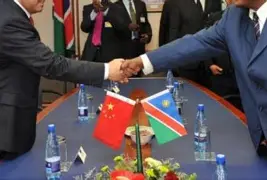
China has strengthened its relationship with Namibia through a series of cooperation agreements.
Recent agreements cover areas including:
- Mining
- Green minerals
- Energy
- Infrastructure
- Agriculture
- Technical training
According to recent reporting, Namibia has signed nine cooperation agreements with China, demonstrating the breadth of the relationship.
This is important because China’s interest is not limited to buying minerals.
The country’s global strength in mining-related manufacturing, processing and industrial supply chains means Chinese investment can potentially help Namibia develop capacity beyond extraction.
That could become one of the most important elements of the relationship.
Europe wants a seat at the table
The European Union has its own strategic reasons for deepening relationships with mineral-producing countries.
Europe wants to reduce vulnerabilities in critical-material supply chains and diversify sources of supply.
The EU’s concern is partly connected to the concentration of processing capacity for certain critical minerals.
China’s position in global mineral processing gives Beijing substantial influence over supply chains that European industries depend on.
That has pushed Europe to search for alternative sources and establish stronger relationships with mineral-producing countries.
Namibia therefore finds itself in an unusual position.
It does not have to choose between having one powerful external partner and having no alternative.
It has competing buyers.
Competition gives Namibia leverage
This is where the geopolitical competition becomes economically useful for Namibia.
When multiple major economies want access to the same resources, the producer country potentially gains negotiating power.
Namibia can ask a much more important question than:
“Who will buy our minerals?”
It can ask:
“What will you build in Namibia if you want access to our minerals?”
That distinction could determine whether Namibia becomes another raw-material exporter or develops a more sophisticated mining economy.
The raw-export trap
African mineral economies have historically faced a fundamental problem.
Countries extract valuable resources but export them in relatively low-value forms.
The higher-value stages of the supply chain often take place elsewhere.
That means the producing country may receive:
- Mining royalties
- Taxes
- Employment income
- Export earnings
But another country can capture much of the additional value created through:
- Processing
- Refining
- Manufacturing
- Technology
- Equipment
- Logistics
- Research and development
Namibia has an opportunity to change that model.
Processing is where the value grows
Mining itself is only one part of the mineral economy.
Consider a simplified supply chain:
Exploration → Mining → Concentration → Processing → Refining → Manufacturing → Finished products
The further Namibia moves along that chain, the greater the potential economic value captured domestically.
That does not mean Namibia should attempt to build every stage immediately.
It means the country should identify where it has a realistic competitive advantage and negotiate investment around those stages.
China can bring industrial capacity
One of China’s biggest advantages is its existing industrial ecosystem.
Chinese companies have extensive experience in mining, infrastructure, processing, manufacturing and logistics.
That means Chinese investment could potentially help Namibia develop infrastructure and processing capabilities faster than if the country relied exclusively on domestic capital.
But there is an important condition.
Investment should create Namibian industrial capacity rather than simply facilitate mineral exports.
That means agreements need to be structured around measurable local benefits.
Europe can offer another model
The European Union presents a different opportunity.
Europe is seeking secure mineral supplies but also increasingly emphasises standards, sustainability, traceability and responsible supply chains.
Namibia can use this competition to seek partnerships that support:
- Mineral processing
- Renewable energy
- Technical training
- Environmental management
- Research
- Local manufacturing
- Skills development
The goal should not necessarily be to choose China over Europe or Europe over China.
Namibia could potentially use both relationships strategically.
The real prize is technology transfer
One of the most important elements of any mineral agreement should be technology transfer.
Namibia does not simply need foreign companies to extract its resources.
It needs Namibians to develop the expertise required to operate increasingly sophisticated mining and processing industries.
That means agreements should address:
Training
Local workers should receive technical skills that remain valuable beyond a single mining project.
Engineering
Namibian engineers and technicians should participate in project development and operations.
Research
Universities and research institutions should be linked to mining and processing projects.
Management
Local professionals should have pathways into senior operational and executive positions.
Infrastructure could be another major benefit
Mining investment can also help solve one of Namibia’s biggest economic constraints: infrastructure.
Large-scale mineral projects require:
- Roads
- Railways
- Ports
- Electricity
- Water
- Telecommunications
- Logistics infrastructure
If negotiated properly, mineral investment can therefore create infrastructure that benefits the broader economy.
This is particularly important because infrastructure can unlock industries beyond mining.
Namibia should negotiate for downstream industries
The most ambitious outcome would be for Namibia to develop downstream manufacturing linked to its mineral resources.
That could mean moving progressively from:
Ore → processed mineral → refined material → industrial component
rather than:
Ore → export
The second model generates export revenue.
The first can create an industrial ecosystem.
That ecosystem can support small businesses, engineering companies, logistics firms, technology providers and specialised services.
The government has to protect its leverage
The danger is that competition can disappear once a project is awarded.
Once a company controls a large mineral asset or supply agreement, the producer country’s negotiating position can weaken.
That means Namibia needs strong legislation and carefully structured contracts before projects are approved.
Important questions include:
- What percentage of the mineral is processed locally?
- How many jobs are created?
- What skills are transferred?
- How much infrastructure is built?
- What taxes and royalties are paid?
- What environmental obligations apply?
- What happens when commodity prices rise?
- How much local procurement is required?
- What happens when the project closes?
These issues matter more than the headline investment figure.
Namibia should avoid choosing sides too early
The greatest strategic mistake would be treating mineral diplomacy as a simple choice between China and Europe.
Namibia can potentially work with both.
China may offer speed, infrastructure and industrial capabilities.
Europe may offer access to markets, technology, financing and supply-chain diversification.
The smartest strategy could therefore be competitive alignment.
Namibia should allow external partners to compete for access while setting clear national requirements.
The global mineral race is accelerating
Namibia’s situation is part of a much larger global trend.
Critical minerals are increasingly being treated as strategic assets rather than ordinary commodities.
Countries are now competing not only for oil and gas but also for lithium, rare earths, copper, uranium and other minerals that underpin modern technology and energy systems.
The geopolitical importance of these materials is rising rapidly.
That means Namibia’s mineral wealth could become considerably more valuable over the next decade.
But geological wealth does not automatically create economic prosperity.
Policy determines how much of that value remains in the country.
Namibia’s biggest opportunity
Namibia now has an opportunity to make a fundamental shift.
Instead of asking:
“How much can we earn from exporting this mineral?”
the country should ask:
“How much of the entire value chain can we build here?”
That changes the conversation from mining to industrialisation.
It also changes the role of foreign investors.
They are no longer simply buyers or operators.
They become potential partners in building Namibia’s industrial base.
The bottom line
The growing competition between China and the European Union for Namibia’s minerals presents the country with a rare opportunity.
Namibia has resources that major economies increasingly need.
China wants stronger access and has already expanded cooperation across mining, energy, infrastructure and green minerals. Europe is simultaneously looking to diversify its critical-mineral supply chains.
Namibia should use that competition to negotiate harder.
The objective should not simply be higher mineral exports.
It should be more processing, more technology, more infrastructure, more skilled jobs and more Namibian companies participating in the value chain.
The country does not have to decide whether China or Europe is the winner.
It has to ensure that Namibia is the winner.
Because the real value of Namibia’s minerals will not be determined by who digs them out of the ground.
It will be determined by who controls what happens after they leave the mine.