
ANC Drops, MK Leads KZN, DA Leads Joburg
ELECTIONS LIVE: ANC Support Plunges as MK Party Leads KZN and DA Surges in Johannesburg
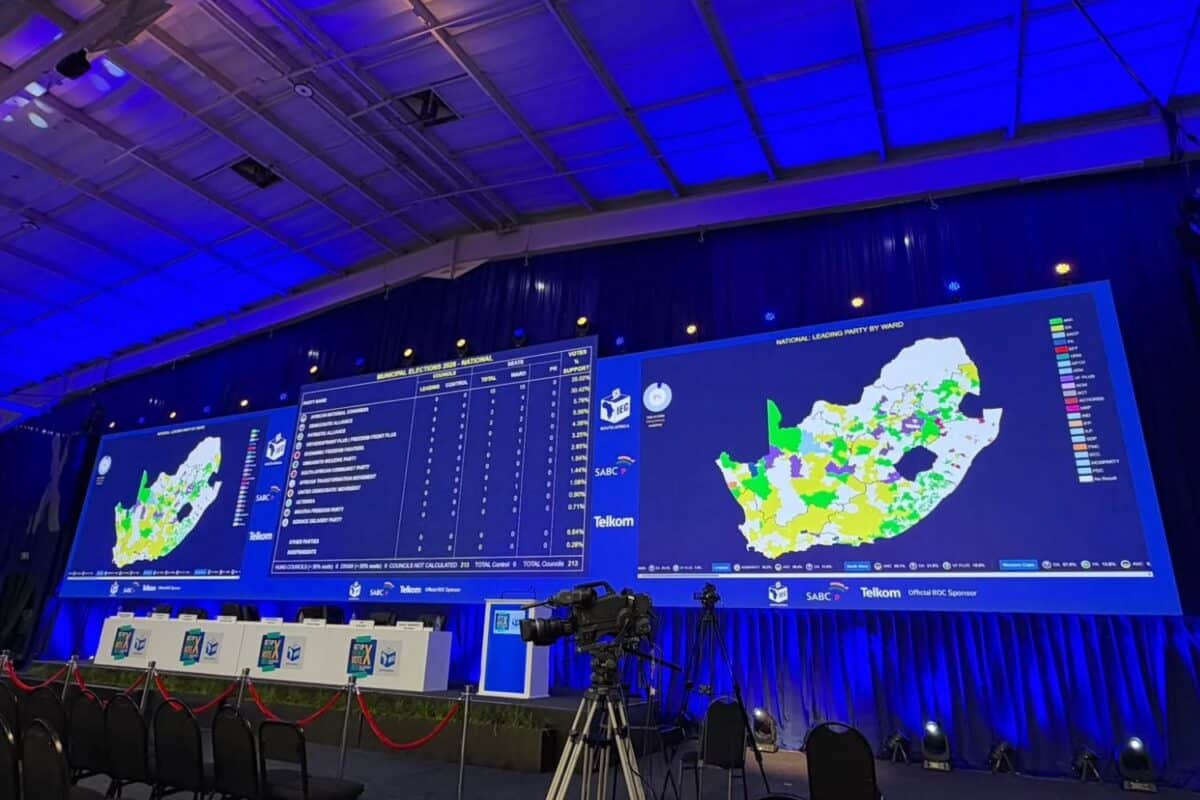
South Africa’s 2026 local government election results are revealing significant changes in the country’s political landscape, with the African National Congress (ANC) experiencing a sharp decline in its national vote share, the uMkhonto weSizwe (MK) Party leading in KwaZulu-Natal and the Democratic Alliance (DA) performing strongly in Johannesburg.
By early Friday morning, more than 71% of voting districts had reported results, bringing the country closer to determining the composition of its municipal councils.
The ANC remained the largest party nationally in an earlier IEC-derived count, but its provisional support of approximately 31.7% was substantially below the 45.59% it secured in the 2021 local government elections.
The DA was in second place nationally, while the MK Party had emerged as an important force in KwaZulu-Natal during its first municipal election campaign.
However, the results remain incomplete, and political parties cannot claim control of municipalities until the relevant council results and seat allocations have been confirmed.
ANC Faces Major Decline in National Support
The ANC is confronting one of its most difficult local government election performances since South Africa’s democratic transition.
An IEC-derived results snapshot at 00:53 on Friday showed the party receiving 31.7% of the counted national vote, compared with the DA’s 25.1% and the MK Party’s 8.6%.
The ANC received 45.59% nationally in the 2021 municipal elections.
If its current vote share remains near the early Friday figure, it would represent a decline of almost 14 percentage points from the previous election.
The party has faced criticism over municipal service delivery, infrastructure failures, corruption and the financial condition of several councils.
Water shortages, electricity disruptions, deteriorating roads and waste collection have featured prominently in public debate during the election campaign.
Nevertheless, incomplete results cannot establish the ANC’s final vote share or the number of councils it will govern.
MK Party Leads KwaZulu-Natal With 34.2%
KwaZulu-Natal has emerged as one of the most closely watched provinces in the 2026 elections.
The MK Party, associated with former president Jacob Zuma, was leading the province’s provisional ward-ballot count with 34.2%.
The Inkatha Freedom Party followed with 22.9%, while the ANC stood at 22.0%.
The DA had received 10.8% of the counted ward votes.
These figures were based on results from 3,293 of KwaZulu-Natal’s 5,028 voting districts.
The results represent an important development for the MK Party, which is contesting local government elections for the first time.
MK Party Records Municipal Gains
The MK Party has also recorded significant performances in several KwaZulu-Natal municipalities.
It secured a majority of council seats in Richmond, with 10 of 17 seats, and in iMpendle, with six of 11 seats.
In Johannes Phumani Pungula Municipality, the party secured 14 of 27 seats.
Other municipalities where the MK Party has performed strongly include Mandeni, Maphumulo, uMdoni, KwaDukuza and Newcastle.
However, leading the vote in a municipality does not necessarily mean a party has secured enough seats to govern independently.
eThekwini: MK Party Leads Early Count
The contest for eThekwini Metropolitan Municipality remains particularly important.
The MK Party was leading the provisional ward-ballot count with approximately 46%, based on 238 of 839 voting districts.
That means less than one-third of the metro’s voting districts had reported in the cited snapshot.
eThekwini is responsible for essential municipal services across Durban and surrounding communities, making the final result significant for residents and businesses.
The council’s eventual composition will determine whether any party can govern alone or whether coalition negotiations will be required.
DA Surges in Johannesburg as ANC Trails
The Democratic Alliance has opened a substantial lead in Johannesburg’s provisional ward-ballot count.
According to IEC-derived municipal results, the DA had secured 41.1% of counted ward votes, followed by the ANC with 16.5% and ActionSA with 14.9%.
The Economic Freedom Fighters stood at 6.9%, while the MK Party had received 5.2%.
The figures were based on 329 of Johannesburg’s 862 voting districts.
Johannesburg Provisional Ward-Ballot Results
| Political party | Vote share |
|---|---|
| Democratic Alliance | 41.1% |
| African National Congress | 16.5% |
| ActionSA | 14.9% |
| Economic Freedom Fighters | 6.9% |
| MK Party | 5.2% |
Johannesburg has experienced repeated changes in political leadership and coalition arrangements since the ANC lost its outright council majority in 2016.
The municipality faces major challenges involving water infrastructure, electricity distribution, road maintenance, refuse collection and financial sustainability.
The final election result will determine whether the DA can translate its provisional lead into a council majority or whether negotiations with other parties will be necessary.
With only 329 voting districts reporting in this snapshot, a final result cannot yet be declared.
DA Also Leads in Tshwane and Ekurhuleni
The DA was also ahead in early results from Gauteng’s other two metropolitan municipalities.
An IEC-derived metropolitan results tracker showed the party leading with approximately 34.6% in Tshwane and 30.5% in Ekurhuleni.
At the time of that snapshot, approximately 59% of voting districts had reported in Tshwane and 56% in Ekurhuleni.
These municipalities have been central to South Africa’s coalition politics in recent years.
The eventual distribution of council seats will be particularly important in determining whether the next administrations can command stable governing majorities.
Western Cape: DA Maintains Strong Lead
The Democratic Alliance continued to lead the Western Cape vote count.
An earlier Thursday evening report placed the party at approximately 54% of the provincial vote, with the ANC and Patriotic Alliance among the other parties receiving substantial support.
In Cape Town, an IEC-derived metropolitan tracker showed the DA ahead with approximately 61.5%.
The Western Cape results also indicate that smaller municipalities may experience different political outcomes from the province’s largest metropolitan council.
Some municipalities have produced outright majorities, while others face the possibility of coalition arrangements.
Eastern Cape: ANC Faces Competition in Major Municipalities
The Eastern Cape remains another province to monitor closely.
In Nelson Mandela Bay, the DA was leading the provisional metropolitan count with approximately 44.1%.
In Buffalo City, the ANC remained ahead with approximately 41.7%.
The differing results illustrate how party support can vary substantially between municipalities within the same province.
The Eastern Cape’s final results will determine the composition of councils responsible for major urban centres and rural communities.
Why Coalition Negotiations Could Become Important
South Africa’s municipal election system combines ward representation with proportional representation.
The final allocation of seats determines which political parties can form municipal governments.
A party may receive the largest share of votes without winning enough seats to govern alone.
Where no party has a majority, political parties may negotiate coalition agreements or other arrangements to elect mayors and establish administrations.
This is especially relevant in major metropolitan municipalities where support is divided among several parties.
The final seat allocations, rather than provisional vote percentages alone, will determine the available governing options.
IEC Continues Verification and Auditing
The Electoral Commission continues processing voting-station results, verifying captured information and resolving outstanding electoral matters.
Although most voting districts had reported by early Friday, the outstanding results could still change party percentages and the composition of closely contested councils.
The IEC’s official results platform remains the authoritative source for final municipal outcomes.
Political parties and members of the public have been encouraged to distinguish provisional results from confirmed council seat allocations.
What Happens Next?
Attention will increasingly turn towards municipalities where counting is nearing completion.
The final results will reveal which parties have secured outright majorities, where coalition negotiations will be required and how local political representation has changed since 2021.
Johannesburg, Tshwane, Ekurhuleni, eThekwini and Nelson Mandela Bay remain among the most important metropolitan contests.
The performance of the MK Party in KwaZulu-Natal and the ANC’s national decline will also remain major subjects of political analysis.
Conclusion
South Africa’s 2026 municipal elections are producing significant changes in party support.
The ANC remains the largest party nationally in the verified early count but has experienced a substantial decline compared with 2021.
The MK Party is leading the provisional ward-ballot count in KwaZulu-Natal, while the DA is recording strong performances in Johannesburg and several other metropolitan municipalities.
However, counting remains incomplete, and final municipal council results will determine the political consequences of these developments.
Ubuntu9Media will continue tracking the election results as the IEC releases verified updates.
Reporting based on IEC-derived election results
Last updated: 6 November 2026. Latest provincial snapshot: 04:49 SAST. Municipal and national figures are drawn from separately timestamped provisional counts.


Pingback: MK Party Open to Coalitions but Sets Firm Conditions - Ubuntu99Media