MK Party Open to Coalitions but Sets Firm Conditions
MK Party Says Door Remains Open to Coalitions, but Sets Firm Conditions on Land Reform and Political Principles
The uMkhonto weSizwe (MK) Party has confirmed that it remains open to forming coalition governments following South Africa’s 2026 local government elections, but says any agreement must be based on shared political principles rather than the pursuit of political positions. ANC Drops, MK Leads KZN, DA Leads Joburg
The party has identified land reform, economic transformation and ideological compatibility as important considerations in deciding which political organisations it could work with.
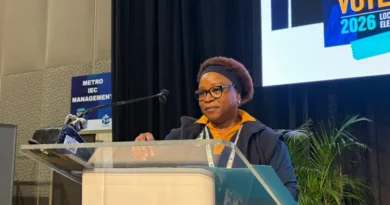
MK Party acting deputy secretary-general and national spokesperson Sifiso Mahlangu outlined the position at the Electoral Commission’s Results Operations Centre at Gallagher Convention Centre in Midrand on Thursday, 5 November.
His comments come as the party records substantial electoral support in KwaZulu-Natal and prepares for the possibility of coalition negotiations in municipalities where no political party secures an outright majority.
Former president and MK Party leader Jacob Zuma reinforced the party’s willingness to negotiate on Friday, saying it was open to coalitions where necessary.
However, no coalition agreement involving the MK Party has been confirmed.
MK Party Says Coalition Talks Must Follow Final Election Results
Mahlangu said the MK Party would not rush into coalition negotiations while the IEC was still processing election results.
According to the party, discussions should begin only after the final results have been officially declared and the composition of municipal councils becomes clear.
The party maintains that its primary objective is to implement the political programme presented to voters during the election campaign.
Mahlangu said the MK Party had not entered the municipal elections simply to participate in coalition governments.
Instead, he argued that any governing arrangement should enable the party to pursue its stated policy commitments.
This position could influence negotiations in KwaZulu-Natal and other municipalities where the party secures council representation.
Land Reform Emerges as a Central Coalition Condition
One of the most significant conditions raised by Mahlangu concerns land reform.
The MK Party has made land ownership and economic transformation central elements of its political programme.
Mahlangu indicated that the party would be unwilling to compromise on its position concerning the land question merely to secure participation in a municipal government.
He argued that abandoning the party’s stated principles would amount to disregarding the mandate received from its supporters.
However, the party has not yet published a detailed municipal coalition agreement specifying how its land reform policies would be incorporated into local government programmes.
The practical implications of this position would depend on the powers available to municipalities, applicable legislation and the terms of any future coalition agreement.
Land reform is a complex policy area involving national legislation, constitutional requirements and the responsibilities of different spheres of government.
Municipalities also exercise powers over land-use planning, zoning, municipal property and aspects of local development.
Ideological Compatibility Will Guide Partnerships
The MK Party says it will consider governing arrangements with political organisations that share its broader outlook on transformation and governance.
Mahlangu emphasised that partnerships should not be formed solely for the purpose of allocating mayoral positions or other municipal offices.
Instead, the party wants potential coalition partners to agree on the policies and programmes that would guide an administration.
The approach places political compatibility at the centre of the party’s negotiations.
However, the MK Party has not publicly identified a complete list of parties it would be willing to work with following the 2026 election.
Its earlier position on Johannesburg provides an indication of the limits it may apply.
MK Party Previously Ruled Out DA Coalition in Johannesburg
Before the 4 November municipal elections, Mahlangu stated that the MK Party would not enter a coalition with the Democratic Alliance in Johannesburg.
The party cited differences in political principles and approaches to transformation.
At the time, Mahlangu said other potential partnerships would be assessed after the election, based on policy compatibility and an agreed governing programme.
The MK Party also identified improved municipal revenue collection, credible budgets and stronger financial controls as priorities for Johannesburg.
The earlier exclusion of the DA in Johannesburg remains relevant, although it should not automatically be interpreted as a nationwide prohibition without a further statement from the party.
Any change to that position would need to be confirmed by the MK Party.
Jacob Zuma Confirms Willingness to Enter Coalitions
Former president Jacob Zuma also addressed the possibility of coalition governments on Friday, 6 November.
Speaking to journalists outside the Durban High Court, Zuma confirmed that the MK Party was willing to participate in coalition discussions.
He said the party wanted to contribute to the governance of the country and its municipalities.
Zuma also expressed satisfaction with the MK Party’s performance in KwaZulu-Natal, where provisional election results showed the organisation leading the provincial count.
He did not disclose the party’s preferred mayoral candidate when questioned about its plans for local government.
His comments reinforced the party’s stated openness to negotiations while leaving the details of potential partnerships unresolved.
MK Party Leads KwaZulu-Natal as Counting Continues
KwaZulu-Natal has become a central focus of the MK Party’s municipal election campaign.
According to an IEC results snapshot reported at approximately 14:00 on Friday, 82% of votes in the province had been counted.
The provisional provincial results showed:
| Political party | Vote share |
|---|---|
| MK Party | 34.12% |
| Inkatha Freedom Party | 22.67% |
| African National Congress | 21.01% |
The figures represent an incomplete count and are subject to change as the IEC finalises outstanding results.
The MK Party’s performance has increased attention on potential coalition arrangements involving the party, particularly in municipalities where council seats are divided among several political organisations.
However, provincial vote percentages do not directly determine which party governs each municipality.
Municipal governments are established according to the seats allocated within their individual councils.
eThekwini Remains a Key Municipality
The contest for eThekwini Metropolitan Municipality is particularly important because of the municipality’s economic significance and large population.
Provisional results reported on Friday indicated that the MK Party was receiving approximately 40% of the vote in the metro at that stage of counting.
That figure did not establish an outright council majority.
The final allocation of seats will determine whether the party can govern independently or requires support from other political organisations.
If no party obtains a majority, coalition negotiations or other council arrangements may be necessary to elect municipal leadership and approve governing programmes.
The MK Party has not confirmed a coalition partner or announced a final mayoral candidate for eThekwini.
ANC Signals Openness to Coalition Discussions
The African National Congress has also indicated that it is prepared to engage with other political parties as the election results are finalised.
Speaking to IOL on Friday, ANC Moses Mabhida regional coordinator Zet Luzipho said the party was willing to work across political lines, subject to guidance from its provincial and national leadership.
Luzipho acknowledged the ANC’s weaker performance in KwaZulu-Natal and said the party respected the choices made by voters.
He indicated that potential partnerships should be assessed according to the issues and governance commitments under discussion.
The ANC’s national leadership has similarly said that formal coalition decisions will follow internal consultation and consideration of the final election results.
These statements do not establish that the ANC and MK Party have reached an agreement or entered formal negotiations with each other.
Other Political Parties Outline Coalition Conditions
The MK Party is not alone in setting conditions for possible municipal partnerships.
The Freedom Front Plus has said it would prioritise service delivery and action against corruption when considering coalition arrangements.
ActionSA has identified improved municipal services, stronger financial management and measures addressing illegal immigration among its priorities.
The Democratic Alliance has also indicated that it will assess coalition arrangements according to its governing principles and the results in individual municipalities.
These positions demonstrate that coalition discussions may involve substantial differences over policy, administration and political accountability.
Any agreements will need to address the practical responsibilities of municipal government, including budgets, infrastructure maintenance and essential services.
Why Coalition Agreements Matter to Municipal Residents
Coalition governments arise when no single political party has enough council seats to govern independently.
Parties may then negotiate arrangements to elect mayors, appoint municipal leadership and support budgets and council decisions.
Such agreements can determine how municipalities approach service delivery, financial management and infrastructure development.
For residents, the consequences are practical.
Municipal administrations are responsible for important services such as water distribution, sanitation, waste collection, local roads and electricity distribution in areas where municipalities hold the relevant responsibilities.
Disagreements between coalition partners can affect decision-making and administrative continuity.
However, the performance of coalition governments varies, and municipal governance problems cannot automatically be attributed to coalitions alone.
The quality of administration, financial controls and implementation of agreed policies also matters.
What Happens After the IEC Announces Final Results?
Once the IEC finalises the election results, parties will know how many seats they have secured in each municipal council.
Where no party has an outright majority, political organisations can begin negotiations over possible governing arrangements.
Municipal councils must hold their first meetings within the legally prescribed period following the declaration of results.
Those meetings are important for electing council leadership and establishing the next municipal administrations.
The MK Party has said it will wait for the final election outcome before entering formal coalition discussions.
Its negotiating position will therefore depend on the actual distribution of council seats and the political programmes of potential partners.
Conclusion
The MK Party has made it clear that coalition governments remain an option following South Africa’s 2026 municipal elections.
However, the party insists that participation in municipal administrations must be guided by ideological compatibility, land reform and the implementation of its political commitments.
Its strong provisional performance in KwaZulu-Natal has placed its coalition position under increased scrutiny.
Former president Jacob Zuma has confirmed the party’s willingness to negotiate, while spokesperson Sifiso Mahlangu has stressed that discussions should begin only after the IEC declares the final results.
For now, no confirmed coalition agreement has been announced.