Touchscreen MacBook Pro Could Cost Over R60k in SA
Apple Launches First Touchscreen MacBook Pro With Prices Expected to Exceed R60,000 in South Africa
JOHANNESBURG, 29 October 2026 — Apple has officially unveiled its first touchscreen MacBook Pro, introducing a major redesign that combines advanced OLED display technology, powerful processors and a new way for users to interact with macOS.
The announcement, made during Apple’s “Pro and tell” product launch on Wednesday, 28 October, marks a significant departure from the company’s longstanding approach to laptop design.
For years, Apple maintained a distinction between touchscreen iPads and MacBooks operated primarily through keyboards and trackpads.
That distinction has now changed.
The new MacBook Pro with PROLED XDR Display allows users to interact directly with their laptop screens, while retaining the keyboard, trackpad and professional computing capabilities associated with the Mac.
However, the latest technology comes at a substantial price.
The 14-inch model starts at $2,899 in the United States, while the larger 16-inch version begins at $3,399.
Although official South African prices have not been announced, local estimates suggest that the new laptops could cost more than R60,000 once imported and sold through local retailers.
Apple Finally Brings Touchscreen Technology to MacBook
The introduction of touchscreen functionality represents one of the most significant changes to the MacBook Pro in years.
Apple has previously concentrated its touchscreen technology on products such as the iPhone and iPad, while positioning the MacBook as a traditional laptop.
The new model changes that approach by integrating touch sensors directly into the display.
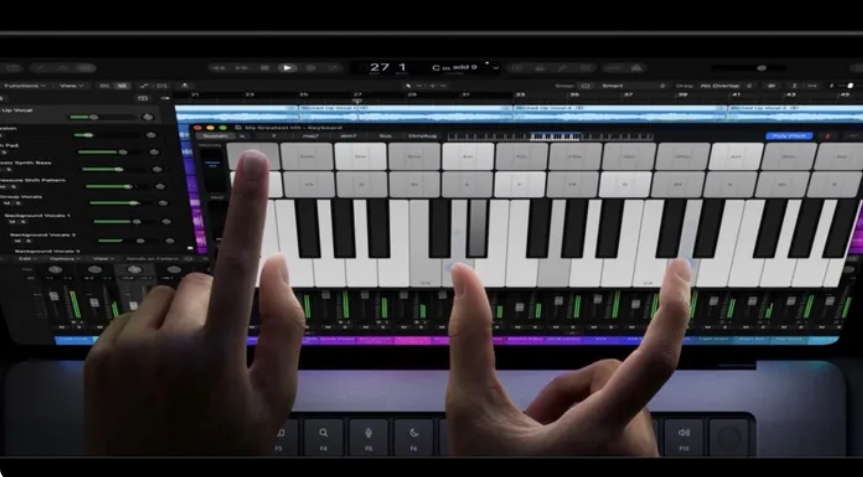
Users can scroll through websites, zoom into photographs, move objects between applications and interact with on-screen controls using their fingers.
The touchscreen also supports professional workflows.
Graphic designers can manipulate artwork directly on the display, video editors can adjust timelines using touch gestures, and musicians can interact with digital instruments.
Apple says the technology has been designed to complement existing keyboard shortcuts and trackpad gestures rather than replace them.
The company has also redesigned the laptop’s hinge to improve stability when users touch the screen.
New PROLED XDR Display Brings OLED to MacBook Pro
One of the biggest upgrades is Apple’s new PROLED XDR display.
The technology uses tandem OLED panels designed to deliver improved brightness, contrast and colour accuracy.
According to Apple’s official specifications, the display offers:
- Up to 2,000 nits of peak brightness for HDR and SDR content.
- A 10,000,000:1 contrast ratio.
- An adaptive refresh rate of up to 120Hz.
- Support for both P3 and Adobe RGB colour spaces.
- An optional nano-texture finish to reduce reflections.
The display is aimed particularly at photographers, graphic designers, video editors and other professionals who require accurate colours and detailed image reproduction.
OLED technology also allows individual pixels to produce their own light, providing deeper blacks and improved contrast compared with conventional LCD technology.
Apple describes the new screen as a major improvement for professional visual workflows.
M5 Pro and M5 Max Chips Deliver Professional Performance
Despite Apple introducing its standard M6 chip earlier in the week, the new touchscreen MacBook Pro uses the higher-performance M5 Pro and M5 Max processors.
These chips are designed for demanding professional applications.
Apple is targeting users working with high-resolution video, 3D modelling, software development, complex graphics and artificial intelligence.
The laptops support up to 128GB of unified memory and storage configurations reaching 16TB.
The increased capacity is intended to support large creative projects and workloads that require substantial memory and storage.
For users working with artificial intelligence applications, Apple says the processors offer advanced capabilities for running demanding tasks locally.
Actual performance will depend on the selected configuration and software being used.
Dynamic Island Makes Its MacBook Debut
Apple has also introduced Dynamic Island to the MacBook Pro.
Previously associated with the iPhone, Dynamic Island provides an interactive area around the camera that displays notifications, system activity and other information.
On the MacBook Pro, the feature supports Spotlight, Live Activities and Siri AI.
The design replaces the traditional display notch with a more interactive interface.
Apple has also brought back the illuminated Apple logo on the rear of the laptop, a design feature associated with older MacBook generations.
The new models are available in silver and space black.
Battery Life Reaches Up to 24 Hours
Apple claims the new MacBook Pro can deliver up to 24 hours of battery life under specified testing conditions.
This is particularly relevant for professionals who work remotely or travel frequently.
The redesigned laptops are also thinner and lighter than comparable conventional MacBook Pro models.
Additional features include a 12-megapixel Center Stage camera, improved speakers, studio-quality microphones and support for fast charging.
Apple says compatible configurations can charge to approximately 50% in 30 minutes.
Battery performance will vary depending on the applications, brightness settings and workload.
Connectivity and Software Features
The new MacBook Pro retains a range of connectivity options intended for professional users.
These include three Thunderbolt 5 ports, an HDMI connection, an SDXC card slot, MagSafe charging and a headphone jack.
Wireless connectivity includes Wi-Fi 7 and Bluetooth 6.
The devices run macOS 27, which introduces touchscreen-specific controls and updated artificial intelligence capabilities.
Apple says existing applications can respond to touch through automatic translation of touch inputs into mouse clicks.
Developers can also create more specialised touchscreen experiences.
Applications identified for touchscreen support include Microsoft Word, Excel and PowerPoint, Adobe Lightroom, DaVinci Resolve, Canva, Notion and Blender.
The extent of touch-specific functionality will vary between applications and software versions.
How Much Will the New MacBook Pro Cost in South Africa?
Pricing is likely to be one of the biggest considerations for South African buyers.
Apple has confirmed the following US starting prices:
| Model | US starting price | Approximate rand conversion |
|---|---|---|
| 14-inch MacBook Pro with PROLED XDR | $2,899 | R48,183 |
| 16-inch MacBook Pro with PROLED XDR | $3,399 | R56,490 |
The rand figures are indicative conversions reported by IOL, not official South African retail prices.
Local prices may be higher because of VAT, exchange-rate movements, distribution costs and retailer pricing.
This means the 14-inch model could approach or exceed R60,000, while higher-specification versions and the 16-inch model could cost considerably more.
Apple has not yet confirmed South African retail prices for the new touchscreen range.
Consumers should therefore avoid treating estimates as final prices.
Why South African Prices May Be Higher
Imported electronics frequently cost more in South Africa than a direct conversion of their US prices might suggest.
Several factors influence the final retail price.
South Africa applies 15% VAT to most consumer electronics.
Exchange-rate movements between the rand and US dollar can also affect the cost of imported devices.
Distribution, logistics, warranty support and retailer operating costs may further influence pricing.
Another important difference is that advertised US prices generally exclude sales taxes, while South African consumer retail prices normally include VAT.
As a result, comparing a US list price directly with a South African shelf price can be misleading.
Who Is the New MacBook Pro Designed For?
The touchscreen MacBook Pro is positioned primarily as a premium professional device.
Its display, memory capacity, processor options and software capabilities are designed for users with demanding workloads.
Potential customers include video production companies, photographers, software developers, architects, graphic designers and music producers.
For these users, direct touchscreen interaction could provide an additional way to work with complex applications.
However, consumers who mainly browse the internet, stream videos, send emails or use standard office applications may not require the advanced specifications.
Apple continues to offer other MacBook models without the new touchscreen display.
The introduction of touch therefore expands the company’s laptop range rather than replacing every existing MacBook.
Apple Enters an Established Touchscreen Laptop Market
Although this is Apple’s first touchscreen MacBook, touchscreen laptops have been available from other manufacturers for years.
Microsoft introduced its Surface range in 2012, helping establish touchscreen Windows devices as an alternative to conventional laptops.
Other manufacturers have also introduced touchscreen and convertible designs.
Apple’s approach differs by integrating touch into a conventional professional laptop rather than converting the device into a detachable tablet.
The company is maintaining the familiar MacBook form factor while adding a new interaction method.
The long-term success of the approach will depend partly on how effectively developers adapt their applications and whether customers consider touch useful enough to justify the higher price.
When Will the Touchscreen MacBook Pro Be Available?
Apple opened pre-orders in selected international markets on 28 October 2026.
The new laptops are scheduled to become available from Friday, 6 November.
The company has not confirmed a separate South African release date or local pricing schedule in the information reviewed.
South African consumers interested in purchasing the devices will need to monitor announcements from Apple and authorised local retailers.
A Major Shift for Apple’s Laptop Strategy
The touchscreen MacBook Pro represents a significant change in Apple’s approach to personal computing.
The company has combined touchscreen functionality with a new OLED display, high-performance processors and a redesigned chassis.
For professional users, the result is a laptop that offers more ways to interact with demanding applications.
For South African consumers, however, affordability remains a major question.
With local prices expected to exceed R60,000, Apple’s first touchscreen MacBook Pro is likely to remain a substantial investment rather than an everyday laptop purchase.
Whether the additional features justify the cost will depend on individual needs, professional workloads and the final prices announced by local retailers.