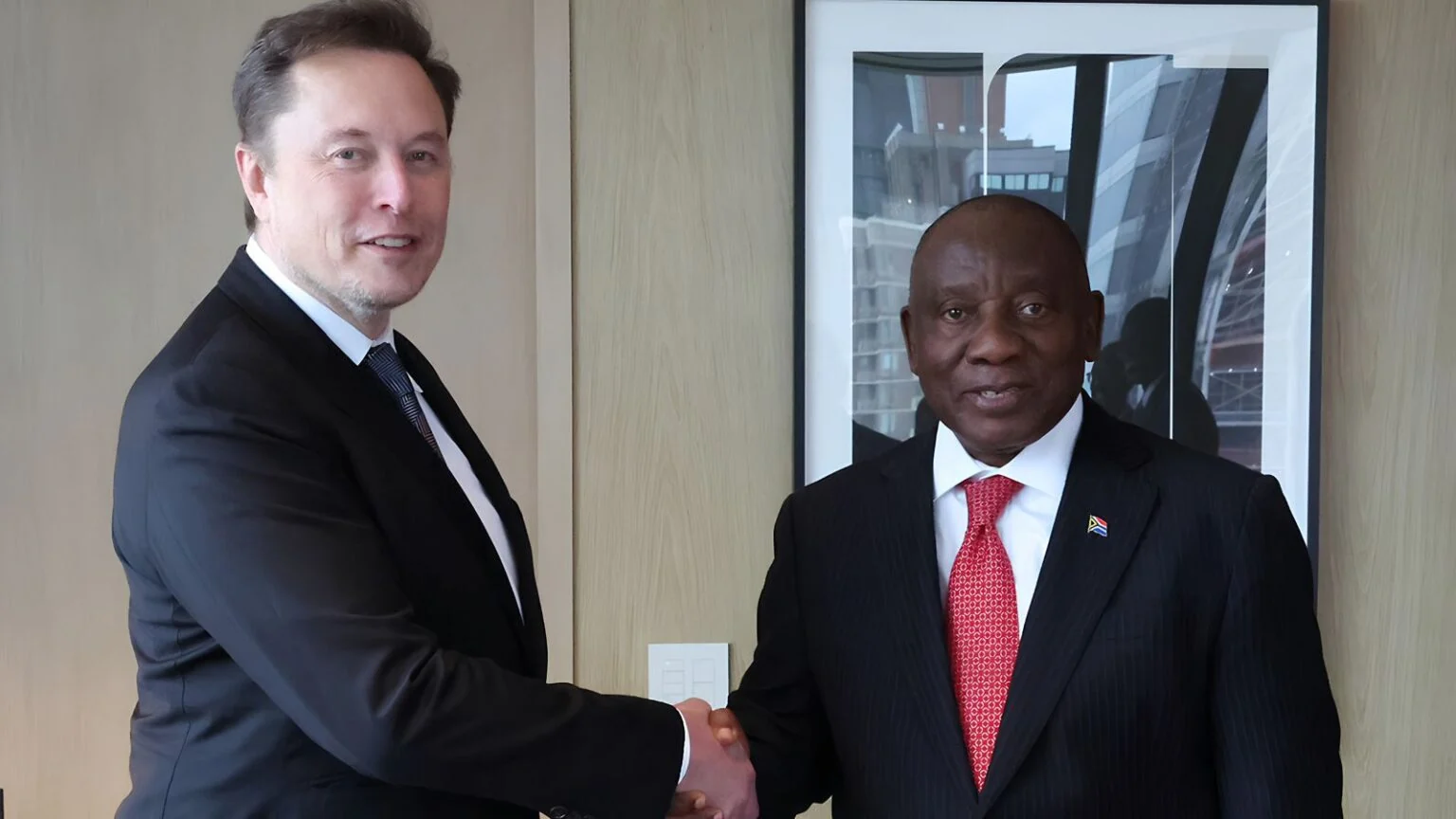
Ramaphosa Says Elon Musk Should Give Back to SA
Ramaphosa Says Elon Musk Owes South Africa — Calls on Billionaire to Give Back to His Birth Country
President Cyril Ramaphosa has called on billionaire entrepreneur Elon Musk to give back to South Africa, arguing that the country played an important role in providing the education and opportunities that helped shape his extraordinary business career.
The president made the remarks during an interview with ABC News chief Washington correspondent Jonathan Karl at the Semafor Silicon Valley & The World event in California.
Ramaphosa, who is leading a South African delegation on a technology-focused working visit to the United States, said Musk should remember his roots despite having established his career and citizenship abroad.
His comments come amid continued disagreements between the South African government and the Tesla and SpaceX chief executive over Black Economic Empowerment (BEE) requirements and the licensing of Starlink’s satellite internet service.
Ramaphosa Wants Elon Musk to Give Back to South Africa
During the interview, Ramaphosa acknowledged Musk’s achievements and described being impressed by his abilities during previous encounters.
However, he argued that Musk’s early development was influenced by the education and opportunities available to him while growing up in South Africa.
The president suggested that Musk should recognise this contribution and use his international success to support the country.
Ramaphosa said he would welcome a conversation with Musk about maintaining a connection with his country of birth.
He argued that acquiring citizenship in another country should not necessarily mean abandoning loyalty to one’s original home.
The president’s appeal was framed around contributing to South Africa’s development rather than repaying a specific financial obligation.
He did not announce a proposed payment, investment commitment or formal financial demand directed at Musk.
Elon Musk’s South African Background
Elon Musk was born in Pretoria in 1971 and spent his early years in South Africa before leaving for Canada as a teenager.
He later moved to the United States, where he became associated with several major technology businesses.
Musk is best known for his leadership roles at Tesla and SpaceX, as well as his involvement with the social media platform X and artificial intelligence company xAI.
His businesses have become influential in electric vehicles, aerospace, satellite communications and artificial intelligence.
Despite his international success, Musk’s relationship with South Africa has often attracted public attention.
His criticism of the country’s economic transformation policies has become a particular source of disagreement with the government.
Ramaphosa Challenges Musk’s ‘Apartheid 2.0’ Claims
The interview also addressed Musk’s previous criticism of South Africa’s transformation policies.
Musk has accused the government of pursuing discriminatory policies and has used the expression “apartheid 2.0” when criticising its approach.
Ramaphosa rejected that characterisation.
He argued that Musk does not fully understand the historical damage caused by apartheid, particularly the unequal treatment of black South Africans.
The president explained that apartheid-era policies systematically restricted access to education, economic opportunities and other resources.
He used disparities in historical education spending to illustrate the inequality.
Ramaphosa said that for every R12 the apartheid government spent on Musk’s education, it spent R1 on his own.
The comparison was presented as the president’s illustration of apartheid-era inequality, rather than a verified accounting of the two men’s individual education costs.
Ramaphosa maintained that understanding this history is essential to understanding why South Africa continues to pursue policies aimed at addressing economic inequality.
Musk Disagrees With South Africa’s BEE Policies
One of the main sources of tension between Musk and the South African government is the country’s Broad-Based Black Economic Empowerment framework.
B-BBEE is intended to increase economic participation by groups disadvantaged under apartheid.
Certain telecommunications licensing requirements include ownership provisions for historically disadvantaged South Africans.
Musk has criticised these requirements, arguing that they discriminate against him and complicate Starlink’s ability to operate in South Africa.
The government maintains that transformation policies are intended to address historical inequality and expand participation in the economy.
The dispute reflects a broader disagreement over how South Africa should balance economic redress, investment attraction and market access.
Why Starlink Is Still Not Operating in South Africa
Starlink, the satellite internet service operated by SpaceX, has expanded into several African countries.
However, it has not secured the necessary authorisation to launch its services commercially in South Africa.
A central obstacle has been the country’s telecommunications licensing and ownership requirements.
The regulatory framework includes a requirement relating to at least 30% ownership by historically disadvantaged groups for certain individual licences.
SpaceX has resisted an ownership arrangement that would require it to surrender a substantial stake in its South African operation.
The South African government has maintained that companies wishing to operate in the country must comply with applicable laws.
During his interview, Ramaphosa confirmed that discussions had taken place regarding Starlink’s potential entry into the South African market.
However, he indicated that disagreements over policy conditions remained unresolved.
Could Starlink Enter Through an Alternative BEE Arrangement?
The government has also considered alternative approaches to meeting transformation requirements.
Communications Minister Solly Malatsi previously proposed exploring equity-equivalent investment programmes.
Such arrangements could potentially allow qualifying companies to support transformation objectives through approved investments or development initiatives rather than direct equity transfers.
However, the Independent Communications Authority of South Africa (Icasa) has indicated that aspects of the proposal cannot be implemented without changes to the existing legal framework.
The issue has also attracted legal challenges.
Consequently, the existence of a proposed alternative does not mean that Starlink has received regulatory approval.
Any eventual launch would still depend on compliance with the applicable licensing requirements and regulatory decisions.
Ramaphosa Says Foreign Companies Must Respect Local Laws
Ramaphosa defended South Africa’s right to establish conditions for companies seeking to operate within its borders.
He argued that countries around the world, including the United States, have rules governing market access and business operations.
The president’s position is that foreign companies should not expect exemptions simply because they are internationally successful.
This argument is particularly relevant to Starlink, which could potentially provide satellite internet connectivity to underserved communities.
Supporters of Starlink’s entry argue that satellite technology could improve connectivity in remote and rural areas.
Others maintain that expanding internet access should not come at the expense of the country’s transformation objectives.
The central policy challenge is finding a legally sustainable arrangement that supports connectivity, investment and economic inclusion.
Musk Responds to Ramaphosa’s Remarks
Following the circulation of clips from Ramaphosa’s interview, Musk reportedly responded on X by renewing his criticism of South Africa’s racial transformation policies.
According to reporting by Briefly News, Musk described the country as discriminatory towards white and Asian residents.
The remarks reflect his continuing opposition to the government’s approach.
However, his criticism should be understood as a political position, not proof that South Africa’s current laws are equivalent to apartheid.
The government maintains that its transformation policies are designed to address the consequences of the former system.
The exchange demonstrates how disagreements over historical inequality and contemporary economic policy continue to influence relations between South Africa and prominent international business figures.
Ramaphosa Visits Silicon Valley to Attract Technology Investment
The president’s remarks come during a wider working visit focused on technology, investment and artificial intelligence.
Ramaphosa is leading a delegation that includes government representatives, South African technology businesses and postgraduate students.
The visit is intended to strengthen relationships with major technology companies and explore opportunities for South Africa to participate in the global artificial intelligence economy.
Meetings involving companies such as Microsoft, Google, OpenAI and Anthropic have been discussed as part of the programme.
The president has emphasised the importance of South Africa becoming an active participant in AI development rather than relying exclusively on technologies developed elsewhere.
He has also highlighted the country’s data-centre infrastructure and potential to attract further technology investment.
Artificial Intelligence Creates New Opportunities
Artificial intelligence has become an increasingly important part of global economic development.
Businesses are investing in AI systems to improve productivity, analyse information and develop new products.
For South Africa, potential opportunities include expanding digital infrastructure, improving technology skills and attracting investment.
However, AI development also raises concerns about employment, privacy, cybersecurity and responsible governance.
Ramaphosa has argued that countries should participate in shaping international rules governing artificial intelligence.
He has also warned about the risks associated with technologies that operate without sufficient human oversight.
The Silicon Valley visit therefore forms part of a broader attempt to position South Africa within the changing global technology economy.
What Would It Mean for Musk to Give Back?
Ramaphosa did not specify what form of contribution he would like Musk to make.
Possible forms of private-sector participation could include investment in local technology businesses, digital skills programmes, research partnerships or expanded internet infrastructure.
However, these are potential examples of development contributions, not commitments announced by Musk or demands formally issued by the president.
Any investment would need to operate within South Africa’s applicable legal and regulatory framework.
The wider question is whether the two sides can move beyond their disagreements and identify areas of cooperation.
For South Africa, investment in technology and digital infrastructure could support economic development.
For Musk’s businesses, the country represents a potentially significant market.
Conclusion
President Cyril Ramaphosa’s message to Elon Musk is that global success should not erase a person’s connection to their country of origin.
During his Silicon Valley visit, the president argued that Musk benefited from opportunities available to him in South Africa and should consider contributing to its development.
He also defended the country’s economic transformation policies and rejected Musk’s criticism of them as a return to apartheid.
The disagreement remains closely connected to Starlink’s unresolved licensing position in South Africa.
While both sides have previously engaged, no agreement has been announced that would allow Starlink to launch commercially in the country.
For now, Ramaphosa’s appeal highlights the continuing tension between investment opportunities, historical inequality and the rules governing foreign companies.