Israel election results 2026
Netanyahu Leads, Majority Elusive
JERUSALEM, 28 October 2026 — Israeli Prime Minister Benjamin Netanyahu’s Likud-led political bloc has emerged ahead in the partial count of Israel’s parliamentary election, but the results suggest that forming a government could require difficult coalition negotiations.
With 72.4% of ballot boxes counted on Wednesday morning, projections based on the Central Elections Committee’s figures gave Netanyahu’s political alliance 54 seats in the 120-member Knesset.
The opposition bloc led by former military chief Gadi Eisenkot stood at 48 seats, while predominantly Arab political parties accounted for another 18 seats.
The numbers leave Netanyahu’s bloc seven seats short of the 61 required for a parliamentary majority.
The opposition also lacks a majority without additional support.
The results are provisional, with more ballots still to be counted before the final parliamentary composition is established.
Netanyahu’s Bloc Takes The Lead
Netanyahu’s Likud party remained the largest individual party in early projections, reflecting continued support for the prime minister despite political divisions over his leadership.
However, Israel’s electoral system requires political parties to negotiate alliances to form a government.
Winning the largest number of seats as an individual party does not automatically guarantee the premiership.
The crucial question is whether Netanyahu can assemble the support of at least 61 lawmakers.
Earlier projections showed his bloc with 56 seats, but subsequent counting reduced its projected representation to 54.
The movement illustrates how the parliamentary picture can change as additional ballots are processed.
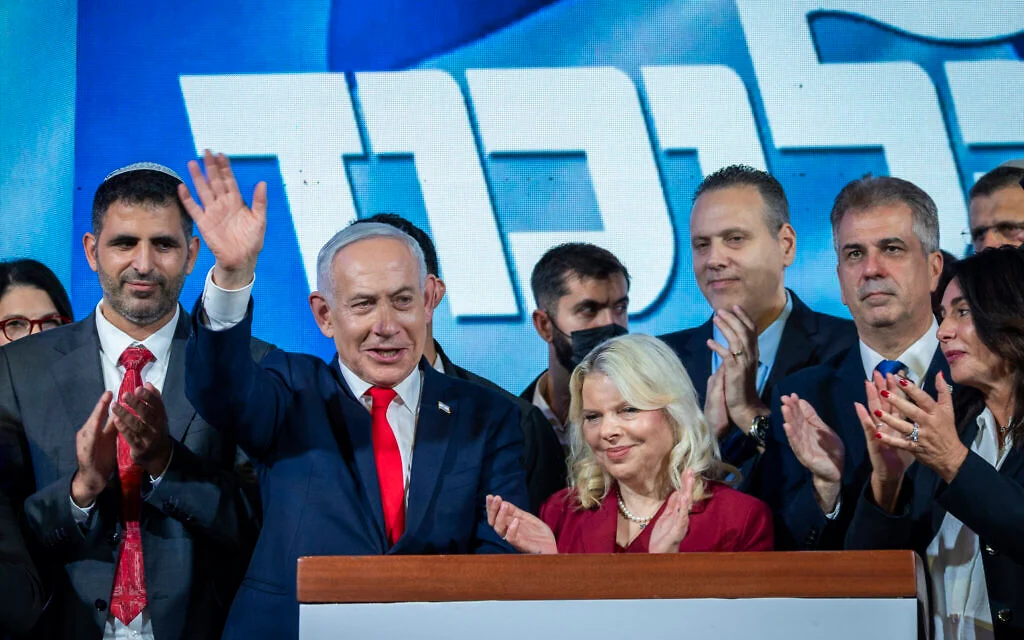
Netanyahu addressed supporters after polling stations closed, expressing confidence in his party’s performance and highlighting his government’s security record.
He also indicated that he wanted to establish a government without relying on Arab-led parties.
Eisenkot’s Opposition Bloc Holds 48 Seats
The political alliance led by Gadi Eisenkot was projected to secure 48 seats at the latest reported stage of counting.
Eisenkot, a former chief of staff of the Israeli military, has positioned himself as an alternative to Netanyahu’s leadership.
His Yashar party campaigned on issues including national security, government accountability and institutional reform.
Following the election, Eisenkot told supporters that the result reflected public demand for political change.
However, the partial figures do not establish that he has sufficient parliamentary support to form a government.
The opposition bloc includes parties with differing political priorities and positions on security, religion and governance.
Reaching a coalition agreement would require negotiations over leadership, policy commitments and the distribution of ministerial responsibilities.
Arab Parties Reach 18 Seats
One of the most consequential developments in the election has been the performance of predominantly Arab political parties.
The latest partial results placed their combined representation at 18 seats.
This included gains for Ra’am, the United Arab List.
Arab political parties represent a range of views and interests, including concerns about crime, economic development, public services, discrimination and the political rights of Palestinian citizens of Israel.
Their increased parliamentary representation could become important in determining whether either main bloc can secure sufficient support to govern.
However, Arab parties are not a single unified political organisation.
Their willingness to cooperate with other parties varies, as do the conditions they may attach to parliamentary support.
The Numbers Behind The Election
| Political grouping | Projected seats | Position |
|---|---|---|
| Netanyahu-led bloc | 54 | Seven short of a majority |
| Eisenkot-led bloc | 48 | Thirteen short of a majority |
| Predominantly Arab parties | 18 | Potentially influential in coalition negotiations |
| Total | 120 | 61 seats required to govern |
The figures are based on the partial count reported on Wednesday morning.
They do not represent certified final election results.
Changes remain possible as additional votes are counted and parties’ final representation is calculated.
Could Arab Parties Determine The Next Government?
The election has placed renewed attention on the possibility of cooperation between opposition parties and Arab lawmakers.
If the Eisenkot-led bloc secured support from enough Arab representatives, it could potentially obtain the parliamentary backing needed to challenge Netanyahu.
For example, the projected 48 seats for Eisenkot’s bloc and 18 seats for Arab parties amount to 66 seats.
However, that arithmetic does not mean the groups have agreed to form a government.
Several opposition politicians have previously expressed reservations about including Arab-led parties in a governing coalition.
Some Arab representatives have also indicated that cooperation would depend on policy commitments.
Possible arrangements could include formal coalition membership, support for a minority government or agreements on individual parliamentary votes.
Each option would involve political negotiations.
The election result alone does not determine which arrangement, if any, will emerge.
Why Israel Held The Election
The 27 October election took place amid deep political divisions over Netanyahu’s leadership and the consequences of regional conflicts.
It was the country’s first parliamentary election since the Hamas-led attacks on Israel on 7 October 2023 and the subsequent war in Gaza.
The attacks killed approximately 1,200 people in Israel, according to Israeli figures, and 251 people were taken hostage.
The ensuing Israeli military campaign in Gaza caused extensive destruction and a major humanitarian crisis, with Palestinian authorities reporting tens of thousands of deaths.
The conflict, alongside military confrontations involving Lebanon and Iran, has shaped Israel’s domestic political debate.
Voters have also expressed concerns about the cost of living, military conscription, government accountability and public security.
The election therefore involved both domestic policy questions and competing approaches to Israel’s regional security challenges.
Netanyahu’s Leadership Under Scrutiny
Netanyahu has served as Israel’s longest-serving prime minister.
His campaign emphasised security, military operations and his relationship with the United States.
Supporters have highlighted his experience and approach to regional threats.
Critics have questioned his government’s handling of the security failures preceding the October 2023 attacks, as well as its conduct during the subsequent conflicts.
Netanyahu has also faced longstanding corruption proceedings, which he denies.
These issues contributed to the polarised political environment surrounding the election.
However, the partial count does not establish a clear parliamentary mandate for either political bloc.
Record Voter Turnout
The election attracted unusually high participation.
According to figures reported from Israel’s Central Elections Committee, voter turnout reached approximately 77.7%.
That represented the highest turnout since 1999 and an increase of around 7.1 percentage points compared with the 2022 election.
Participation was particularly significant in Arab-majority communities, where political mobilisation contributed to the strong performance of Arab-led parties.
The high turnout demonstrates the importance voters attached to the election, although it does not indicate agreement on the country’s political direction.
What Happens After The Vote Count?
Once the election results are finalised, Israel’s president, Isaac Herzog, will consult representatives of the parties elected to the Knesset.
The president will then assign the task of forming a government to the lawmaker judged to have the strongest prospect of assembling a parliamentary coalition.
This is not necessarily the leader of the largest individual party.
The designated candidate must negotiate sufficient parliamentary support.
If that candidate cannot form a government within the permitted period, another candidate may be given an opportunity.
A prolonged deadlock could eventually result in another election.
During the process, Netanyahu’s existing government can continue in a caretaker capacity.
Final Results Still Pending
The Central Elections Committee is expected to complete the official process in the coming days, with formal results anticipated by 4 November.
The remaining ballots include votes submitted through special procedures, including those cast by soldiers.
Changes in party vote shares can affect the distribution of parliamentary seats.
Israel’s electoral threshold of 3.25% also means that parties close to the threshold can influence the final allocation.
For that reason, provisional seat projections should not be presented as confirmed election outcomes.
What The Result Means For The Middle East
Israel’s next government will inherit major challenges involving Gaza, the occupied West Bank, Iran and relations with neighbouring countries.
The political composition of the government could influence approaches to military operations, ceasefire arrangements, diplomacy and regional security.
However, the election does not immediately establish what policies the next government will adopt.
Those decisions will depend on the leadership that emerges from coalition negotiations and the agreements reached between participating parties.
International governments will also be monitoring the process, including the United States and countries involved in regional diplomatic initiatives.
Coalition Negotiations Could Decide The Outcome
Wednesday’s partial count places Netanyahu’s bloc ahead but without the parliamentary majority needed to govern.
Eisenkot’s opposition bloc also remains below the required threshold.
Meanwhile, the stronger representation of Arab political parties has introduced additional possibilities for parliamentary cooperation.
The final distribution of seats could still change.
For now, the election has produced a divided parliamentary picture rather than a confirmed governing majority.
The next phase will be determined by the completion of vote counting and negotiations between political parties.