AKA murder trial CCTV evidence
AKA Trial Witness Challenged
DURBAN, 27 October 2026 — The murder trial of South African rapper Kiernan “AKA” Forbes and his friend Tebello “Tibz” Motsoane took another significant turn on Tuesday when defence lawyers challenged the expertise of a police detective responsible for presenting crucial CCTV evidence. AKA Tibz murder trial
South African Police Service (SAPS) technical detective Rajen Sanders faced cross-examination in the Durban High Court over his ability to identify suspects from surveillance footage collected during the investigation.
The detective acknowledged that he did not possess specialist expertise in facial recognition or analysing people’s physical measurements.
His admission has become an important point of contention as the prosecution attempts to use surveillance recordings to establish the movements of people allegedly involved in the killings.
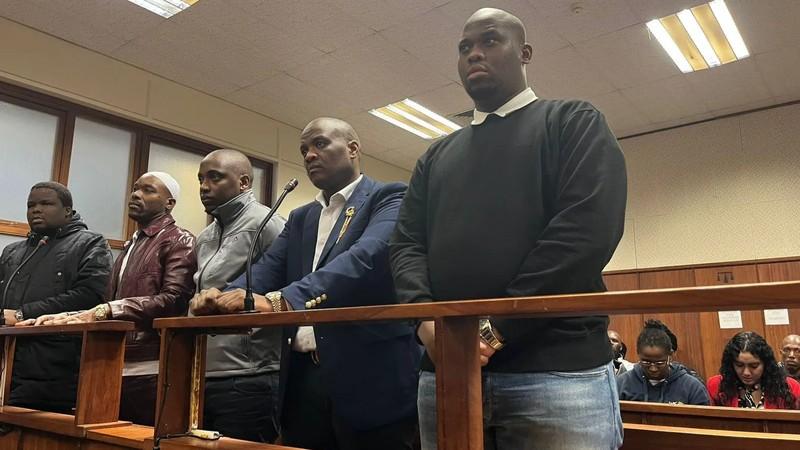
Seven men are standing trial in connection with the murders, which took place outside Wish Restaurant on Durban’s Florida Road on 10 February 2023.
All seven have pleaded not guilty.
Defence Questions Detective’s Qualifications
During Tuesday’s proceedings, defence lawyer Musa Mzelemu challenged Sanders about the basis for his identification of suspects appearing in CCTV recordings.
The lawyer represents accused number five, Mhlaliseni Ndimande.
Sanders previously identified Ndimande as a person allegedly seen following Forbes and observing his movements at Wish Restaurant before the fatal shooting.
The defence questioned whether Sanders had the professional training required to make such an identification.
In particular, the lawyer challenged his expertise in facial recognition and the comparison of physical characteristics.
Sanders acknowledged that he did not possess those specialist qualifications.
The exchange raises an important evidentiary question: whether an investigator’s visual identification of a person in CCTV footage should be treated as sufficiently reliable without specialist identification training.
However, the detective’s acknowledgement does not automatically make his testimony inadmissible or establish that his identification was incorrect.
The court must ultimately determine what evidentiary weight should be attached to his observations.
More Than Three Hours Of CCTV Examined
The prosecution has presented more than three hours of surveillance footage gathered from locations associated with Forbes’s movements on the day he was killed.
The recordings form part of the State’s attempt to reconstruct the events leading up to the shooting.
Sanders collected video material from several locations, including hotels, restaurants, private premises and transport-related sites.
Some footage showed Forbes and his entourage travelling through Durban after arriving at King Shaka International Airport.
Other recordings focused on the area surrounding Wish Restaurant.
The State alleges that individuals connected to the killings monitored the rapper’s movements before the shooting.
Prosecutors have relied on the CCTV recordings to support their account of how the alleged operation unfolded.
The defence is challenging aspects of that interpretation.
Accused Allegedly Seen Watching AKA
One of the central issues involves footage allegedly showing Ndimande inside Wish Restaurant before the murders.
Sanders identified him as a man positioned where he could observe Forbes and the people accompanying him.
According to the prosecution’s interpretation, the individual was allegedly monitoring the rapper’s movements.
The State has suggested that the surveillance was part of a coordinated operation preceding the shooting.
However, the defence is questioning whether the person in the recordings can reliably be identified as Ndimande.
The distinction is important.
Being present at a restaurant or appearing in surveillance footage does not, by itself, establish participation in a murder.
The prosecution must prove the alleged criminal involvement of each accused beyond reasonable doubt.
CCTV Authenticity Also Challenged
The detective’s qualifications were not the only issue raised during Tuesday’s proceedings.
Defence lawyer William Nicholson separately challenged the authenticity of the CCTV evidence.
Nicholson suggested that the possibility of video manipulation or tampering needed to be considered.
This introduces another issue for the court: whether the recordings presented by the prosecution accurately reflect the original footage collected during the investigation.
Police have previously explained the procedures followed when collecting and storing the recordings.
Sanders testified that the footage was downloaded onto storage devices, placed in evidence bags and booked into police custody.
The prosecution is relying on those procedures to support the integrity of the evidence.
However, the defence is entitled to question how the material was obtained, preserved and subsequently handled.
No finding that the CCTV recordings were manipulated has been established by the reported proceedings.
Earlier Objection To Suspect Identification
The defence had already raised concerns about Sanders’s identification evidence during proceedings last week.
On Thursday, lawyers representing accused number four, Mziwethemba Gwabeni, objected when Sanders identified their client as a person allegedly seen following Forbes at King Shaka International Airport.
The defence argued that Sanders was not a specialist in facial identification and that the identification had not been adequately disclosed beforehand.
State prosecutor Lawrence Gcaba opposed the objection.
The prosecution argued that the concerns should affect how the court evaluates the evidence rather than prevent the detective from giving it.
Presiding Judge Nomfundo Sipunzi allowed the testimony to proceed.
The judge indicated that the court would determine the weight of the evidence when assessing the case.
That earlier ruling is relevant to Tuesday’s questioning because the defence is continuing to challenge the reliability of the detective’s identifications.
How Police Reconstructed AKA’s Final Movements
The CCTV evidence has been used to trace Forbes’s movements after his arrival in Durban.
The prosecution has presented footage from King Shaka International Airport, the hotel where the rapper stayed and locations he visited before going to Wish Restaurant.
The State alleges that some of the accused followed Forbes during portions of his journey.
Investigators have also examined vehicles appearing in the recordings.
These include a grey BMW, a Volkswagen Polo and a white Mercedes-Benz allegedly associated with the events surrounding the shooting.
The prosecution has sought to connect vehicles captured on surveillance cameras with other evidence gathered during the investigation.
The defence has challenged parts of these alleged connections.
The footage remains one component of a wider prosecution case that also includes witness testimony and other investigative evidence.
White Mercedes-Benz Under Scrutiny
The court has also heard evidence concerning a white Mercedes-Benz allegedly used by the gunmen to escape after the shooting.
According to the State’s case, two attackers fled across Florida Road after Forbes and Motsoane were shot.
Investigators believe the men subsequently entered a vehicle parked nearby.
A Mercedes-Benz recovered in Cato Manor on 6 March 2023 has become part of the investigation.
Sanders testified that the recovered vehicle had characteristics resembling those visible in the surveillance recordings.
These included similarities involving the vehicle’s appearance, wheels and a headlight that was not functioning.
However, visual similarities alone do not conclusively establish that two recordings or observations involve the same vehicle.
The prosecution must establish the connection through the evidence presented to the court.
The defence has also challenged the admission of photographs associated with the recovered vehicle.
What Happened On 10 February 2023?
Forbes, one of South Africa’s most prominent hip-hop artists, was visiting Durban when he was shot outside Wish Restaurant on Florida Road.
His friend Motsoane, a celebrity chef and entrepreneur, was also killed.
The shooting shocked South Africa and prompted a major police investigation.
Investigators subsequently arrested several suspects and alleged that the killings involved a coordinated operation.
The prosecution’s case includes allegations of surveillance, the use of vehicles and the involvement of multiple individuals in planning or carrying out the attack.
Those allegations remain subject to the court’s assessment.
The accused have denied criminal responsibility.
Why CCTV Evidence Matters
Surveillance footage can play an important role in criminal proceedings because it may help establish where people and vehicles were at particular times.
However, video recordings do not always provide conclusive identification.
Camera quality, lighting, viewing angles, distance, compression and obstructions can affect how clearly a person appears.
There is also a distinction between collecting and preserving footage and possessing specialist expertise in identifying individuals from images.
An investigator may be experienced in retrieving CCTV recordings without being formally trained in forensic facial comparison.
The defence’s questioning focuses on this distinction.
For the prosecution, the challenge is to demonstrate that the identification evidence is sufficiently reliable when considered alongside other testimony and exhibits.
For the defence, the objective is to test whether the State’s conclusions are supported by the recordings.
The judge will ultimately assess the evidence in the context of the entire case.
Seven Accused Remain On Trial
Seven men are facing charges arising from the deaths of Forbes and Motsoane.
The accused include Lindokuhle Thabani Mkhwanazi, Lindani Zenzele Ndimande, Siyanda Eddie Myeza, Mziwethemba Gwabeni, Lindokuhle Mhlaliseni Ndimande, Malusi Dave Ndimande and Siyabonga Gezani Ndimande.
They face charges that include murder, attempted murder and firearm-related offences.
All have pleaded not guilty.
Their guilt or innocence has not been determined.
What Happens Next?
The prosecution will continue relying on witness testimony, surveillance recordings and other evidence to establish its case.
Defence lawyers are expected to continue testing the reliability of the evidence and the conclusions drawn by investigators.
Among the important questions are whether the individuals appearing in the recordings have been correctly identified, whether the footage has been adequately authenticated and whether the evidence proves the alleged roles of the accused.
The court has not yet delivered a verdict.
The latest proceedings underline the importance of distinguishing between what surveillance footage visibly shows and the conclusions investigators draw from it.
For the families of Forbes and Motsoane, the trial remains a significant step in the search for answers about the February 2023 killings.