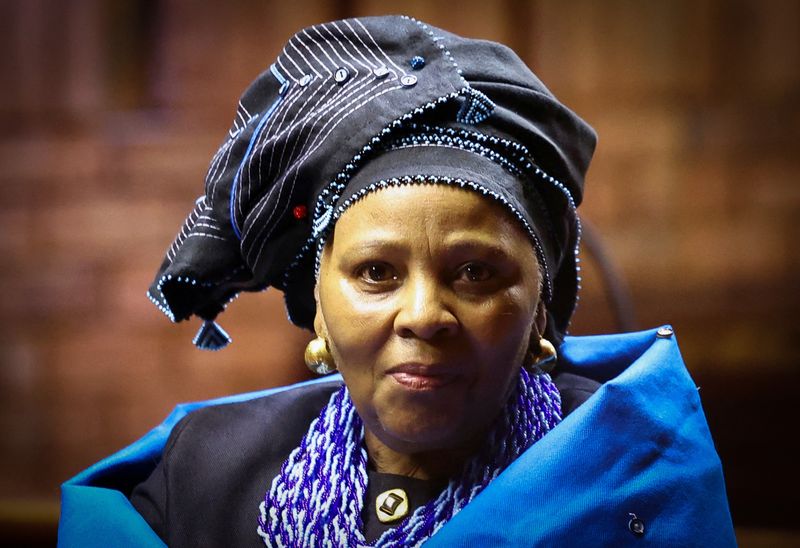
Mapisa-Nqakula Trial Discharge Application Awaiting Judgment
Mapisa-Nqakula Trial Discharge Application
Former National Assembly speaker Nosiviwe Mapisa-Nqakula has asked the Gauteng High Court in Pretoria to discharge her from her R4.55-million corruption and money-laundering trial. Mapisa-Nqakula Trial Continues
Her lawyers argue that although the State presented evidence suggesting that millions of rand changed hands, prosecutors failed to establish the alleged quid pro quo—the official act, favour or benefit supposedly provided in exchange for the money.
Judgment on the Mapisa-Nqakula trial discharge application is expected on Monday, 7 September 2026.
Defence says corruption element missing
Mapisa-Nqakula faces 12 counts of corruption and one count of money laundering linked to her tenure as defence minister between 2016 and 2019.
She has pleaded not guilty to all charges.
The State alleges that Mapisa-Nqakula solicited approximately R4.55 million from defence contractor Nombasa Ntsondwa-Ndhlovu and received more than R2.1 million in cash.
Prosecutors allege that the payments were connected to Mapisa-Nqakula’s official position and Ntsondwa-Ndhlovu’s interests as a South African National Defence Force contractor.
However, defence advocate Siyabulela Mapoma SC argued that proving money was paid was insufficient to establish corruption. The State must also prove that the payment was intended to influence an official action or secure an improper benefit.
The defence contends that Ntsondwa-Ndhlovu did not clearly identify what Mapisa-Nqakula was expected to do—or refrain from doing—in exchange for the alleged payments.
What does quid pro quo mean?
“Quid pro quo” is a Latin expression meaning “something for something.”
Within a corruption case, it generally refers to the link between an alleged payment and an official act, favour or improper benefit. The prosecution must establish the required elements of the offence, including the accused’s alleged intention.
Mapisa-Nqakula’s lawyers argue that the State may have presented evidence of payments but failed to establish the corrupt agreement or intention connecting those payments to her official responsibilities.
They maintain that this missing connection prevents the State from establishing a prima facie case.
State relies on contractor’s testimony
Ntsondwa-Ndhlovu is the central witness in the prosecution’s case. She testified that she made several payments to Mapisa-Nqakula while experiencing problems affecting her defence contracts.
One allegation concerns an alleged demand for R2 million linked to efforts to secure the appointment of Ntsondwa-Ndhlovu’s husband, retired Major-General Noel Ndhlovu, as surgeon-general.
The defence argues that other State witnesses contradicted important aspects of Ntsondwa-Ndhlovu’s evidence.
It also emphasised that she was allegedly the only person who directly witnessed the cash being handed to Mapisa-Nqakula. Other witnesses who testified about the payments obtained their information from Ntsondwa-Ndhlovu, the defence submitted.
Although South African law permits a conviction based on the evidence of a single witness, the defence argued that such testimony must be treated cautiously—particularly where the witness may seek indemnity under Section 204 of the Criminal Procedure Act.
Defence challenges WhatsApp evidence
The Mapisa-Nqakula trial discharge application also challenges the reliability of WhatsApp messages presented by the prosecution.
Mapisa-Nqakula’s lawyers alleged that some messages had been deleted before screenshots were submitted as evidence. They also argued that the people who extracted or copied the messages from Ntsondwa-Ndhlovu’s phone were not called to testify.
According to the defence, this prevents the court from independently confirming the authenticity, completeness and context of the conversations.
The defence also questioned the absence of cellphone and WhatsApp call records that could independently verify alleged communication between Mapisa-Nqakula and Ntsondwa-Ndhlovu.
It further rejected the prosecution’s interpretation of certain words in the messages as codes referring to money.
State says evidence is sufficient
State prosecutor Advocate Emile van der Merwe rejected the defence’s arguments and maintained that the prosecution had presented enough evidence for the trial to continue.
The State acknowledged inconsistencies between some witnesses but argued that these could not be considered separately from the evidence as a whole.
Van der Merwe also disputed the suggestion that the alleged coded messages did not concern money. He argued that Mapisa-Nqakula should be required to present her defence and explain why the alleged payments were not returned.
The prosecution maintains that its witnesses provided honest accounts and that the court can rely on their collective evidence.
What is a Section 174 application?
Section 174 of the Criminal Procedure Act allows an accused person to apply for a discharge after the prosecution closes its case.
The court may acquit the accused at that stage if it finds that there is insufficient evidence on which a reasonable court could convict.
A successful application would mean Mapisa-Nqakula is discharged without being required to testify or call defence witnesses.
If the court rejects the application, the trial will continue and she will be placed on her defence. A refusal would not amount to a finding that she is guilty; it would only mean the State has presented sufficient evidence for the case to proceed.
Mapisa-Nqakula remains presumed innocent unless proven guilty beyond a reasonable doubt.