Tesla Roadster Takes Flight
Tesla Roadster Takes Flight
TEXAS, 16 October 2026 — Tesla has unveiled its long-awaited next-generation Roadster, demonstrating an electric sports car capable of performing extraordinary airborne manoeuvres with technology developed alongside Elon Musk’s rocket company, SpaceX.
The dramatic demonstration took place on Thursday, 15 October, at SpaceX’s testing facilities in Texas, almost nine years after Tesla first introduced its plans for a second-generation Roadster.
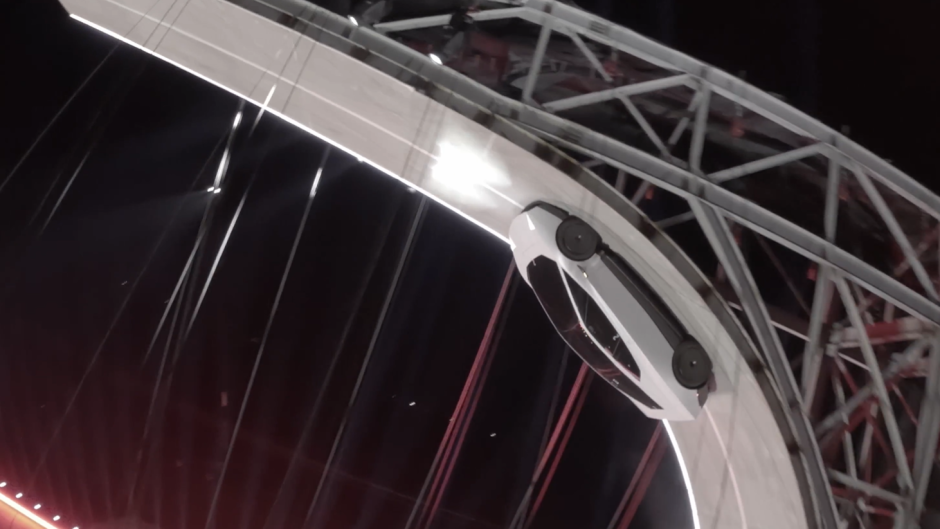
The redesigned white sports car drove upside down on a specially constructed ramp, briefly launched itself into the air, rotated and landed using a combination of powerful fans and integrated thrusters.
Tesla also demonstrated the prototype jumping over several vehicles.
The company says production is planned for 2028, although questions remain about whether these capabilities will be available in road-legal customer vehicles.
Tesla Roadster Demonstrates Flying Technology
The centrepiece of the presentation was a demonstration combining advanced aerodynamics with propulsion technology inspired by SpaceX.
The prototype drove onto a curved ramp and continued upside down using a powerful suction system.
According to Tesla, the system generates enough downward force to keep the vehicle attached to the specially designed surface.
The Roadster then used integrated thrusters to perform a controlled airborne manoeuvre before landing.
A separate demonstration showed the car clearing other Tesla vehicles while in motion.
These demonstrations represent an important development in Tesla’s efforts to combine high-performance electric motoring with unconventional propulsion technology.
However, the ability to perform brief controlled jumps does not establish that the Roadster can operate as a conventional flying car.
SpaceX Technology Powers The Roadster
Tesla has worked with SpaceX engineers on propulsion systems intended to extend the vehicle’s performance beyond the capabilities of ordinary electric sports cars.
Musk first discussed incorporating rocket-inspired thrusters into the Roadster in 2018.
The proposed technology was intended to improve acceleration, braking and cornering, with the possibility of briefly lifting the car off the ground.
The latest prototype demonstrates that Tesla has developed a working system capable of controlled airborne movements under demonstration conditions.
Unlike a conventional aircraft, the Roadster has not been shown performing sustained flight over meaningful distances.
Its propulsion system is therefore better understood as an experimental performance feature rather than an established replacement for aviation technology.
Roadster Accelerates In Under One Second
Tesla also demonstrated extraordinary acceleration performance.
The company claims the prototype can accelerate from zero to 60 miles per hour, approximately 97 kilometres per hour, in less than one second.
That would place it among the quickest-accelerating road-car concepts ever demonstrated.
However, the result was achieved using specialised technology, and independently verified performance figures for a final production vehicle are not yet available.
Tesla has also indicated that the Roadster could exceed 230 miles per hour, or approximately 370 kilometres per hour.
Final specifications may change before production begins.
Production Planned For 2028
The new Roadster has experienced a lengthy development process.
Tesla first revealed the second-generation concept in November 2017 and initially indicated that production would follow within a few years.
The programme was subsequently delayed repeatedly as the company prioritised other vehicles and technologies.
These included the Model 3, Model Y, Cybertruck, autonomous driving systems and robotics.
At the October 2026 presentation, Tesla announced that production is now expected to begin in 2028.
That would place the start of production more than a decade after the initial concept was revealed.
Given the project’s history of delays, the 2028 date should be treated as a company target rather than a guaranteed delivery deadline.
Will The Roadster Be Road Legal?
One of the biggest unanswered questions concerns whether a car equipped with powerful thrusters can legally operate on public roads.
Vehicle regulations generally require manufacturers to demonstrate compliance with safety standards covering braking, lighting, occupant protection and other systems.
The Roadster’s unusual propulsion equipment introduces additional questions about noise, nearby road users and safe operation.
Tesla has not established that its airborne capabilities will be approved for ordinary public-road use.
Regulatory requirements could also differ between countries.
For South African motorists, any future introduction would depend on applicable vehicle approval, importation and roadworthiness requirements.
No confirmed South African launch date or local retail price has been announced.
What Will The Tesla Roadster Cost?
Tesla previously accepted reservations for the second-generation Roadster, including substantial deposits for limited-edition versions.
The company has discussed several configurations, including specialised variants incorporating more advanced propulsion systems.
However, the final purchase prices, production volumes and delivery arrangements have not been fully established.
The high-performance Roadster is expected to serve primarily as a showcase for Tesla’s engineering rather than a mass-market electric vehicle.
Musk has previously acknowledged that the car is unlikely to make a major contribution to Tesla’s overall revenue.
Its significance may instead lie in demonstrating experimental technologies and attracting attention to the brand.
Tesla’s Electric Vehicle Strategy
The Roadster unveiling comes as Tesla continues expanding its focus beyond conventional electric vehicle manufacturing.
The company has invested heavily in autonomous driving technology, robotics and artificial intelligence.
Its existing electric vehicle business remains important, but Tesla has increasingly presented its future growth strategy around automated transport and advanced technology.
The Roadster occupies a different position within this strategy.
Rather than targeting high-volume sales, it is intended to demonstrate the company’s most ambitious performance engineering.
Whether the technologies displayed in Texas eventually influence mainstream Tesla vehicles remains uncertain.
What The Demonstration Proves
The October unveiling established that Tesla has developed a prototype capable of using propulsion-assisted manoeuvres to leave the ground briefly and land under controlled conditions.
It also demonstrated an unusual suction system capable of supporting inverted driving on a purpose-built ramp.
However, several important questions remain unanswered.
These include how the systems perform in ordinary traffic, whether the propulsion technology can meet road safety regulations, and how reliably the vehicle can reproduce its demonstration capabilities.
The presentation also did not establish that customers will receive identical features in the final production model.
Independent testing will be important once a production-ready vehicle becomes available.
What Happens Next?
Tesla’s next challenge is to transform the demonstration vehicle into a production car that can meet relevant safety, reliability and regulatory requirements.
The company is targeting 2028 for production, but its history of delays means the schedule remains subject to change.
For enthusiasts, the latest Roadster represents an unusual attempt to combine electric sports-car performance with technologies more commonly associated with aerospace engineering.
For the wider automotive industry, it raises questions about how far manufacturers can extend vehicle performance while remaining within established safety rules.