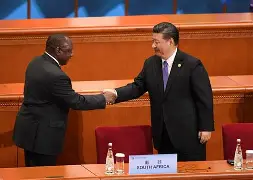
South Africa Wins Chinese Power Backing
South Africa wins Chinese backing for power-expansion plans
JOHANNESBURG – South Africa is deepening its cooperation with China as it looks to expand electricity infrastructure, attract investment and strengthen the country’s long-term energy security.
The relationship comes at an important moment for South Africa’s power sector. While Eskom has made significant progress in improving electricity availability, the country still faces major infrastructure, transmission and generation challenges.
South Africa’s growing engagement with China could provide access to capital, technology, engineering expertise and large-scale infrastructure capabilities.
China becomes an important energy partner
South Africa and China have been strengthening their economic relationship across several sectors, with new energy cooperation specifically included in the countries’ 2026 Framework Agreement on Economic Partnership for Shared Prosperity.
The agreement is designed to enhance Chinese investment into South Africa while expanding cooperation in areas including trade, investment and new energy.
For Pretoria, energy is particularly important because reliable electricity is directly connected to economic growth.
Manufacturing, mining, data centres, logistics and other energy-intensive industries all require dependable and competitively priced electricity.
Why power expansion matters
South Africa’s electricity challenge has changed significantly.
The country has moved away from the worst period of rolling load shedding, but that does not mean the underlying infrastructure problem has disappeared.
Eskom has reported hundreds of days without load shedding, while simultaneously implementing programmes aimed at strengthening distribution networks and addressing load reduction.
The next challenge is therefore increasingly about expanding and modernising the electricity system.
That includes:
- New generation capacity.
- Transmission infrastructure.
- Distribution networks.
- Battery storage.
- Renewable energy integration.
- Grid modernisation.
- Smart electricity systems.
Chinese expertise could accelerate infrastructure
China has developed significant capabilities in large-scale infrastructure construction, manufacturing and energy technology.
For South Africa, cooperation could therefore extend beyond simply securing financing.
Potential benefits include access to:
Engineering expertise: Chinese companies have extensive experience delivering large infrastructure projects.
Energy technology: China is a major manufacturer of solar panels, batteries and other clean-energy equipment.
Transmission capability: Expanding electricity generation is of limited value if the grid cannot transport power to where it is needed.
Industrial development: Energy infrastructure can create opportunities for local manufacturing, construction and engineering companies.
Transmission may be the real bottleneck
One of South Africa’s biggest electricity challenges is no longer simply generation.
It is increasingly the ability to move electricity across the country.
Large renewable-energy resources are concentrated in areas such as the Northern Cape and Western Cape, while major electricity demand is concentrated around economic centres including Gauteng.
This creates a fundamental infrastructure requirement.
South Africa needs sufficient transmission capacity to move electricity from generation zones to demand centres.
Without that investment, new renewable-energy projects can face delays in connecting to the national grid.
Renewables are changing the electricity equation
South Africa’s future power system is expected to contain a much larger share of renewable energy.
Solar and wind generation can be deployed relatively quickly compared with large conventional power stations, but they also create technical challenges because their output varies according to weather conditions.
That makes battery storage, flexible generation and stronger transmission networks increasingly important.
President Cyril Ramaphosa has described energy security, resilience and sustainability as central to Africa’s development ambitions.
China’s strength in renewable-energy manufacturing could therefore become increasingly relevant to South Africa’s energy strategy.
The battery opportunity
Energy storage could become one of the most important areas of cooperation.
Batteries can store electricity generated during periods of strong solar or wind production and release it when demand rises or renewable generation falls.
This helps reduce the intermittency challenge associated with renewable energy.
For South Africa, large-scale battery storage could potentially help stabilise the grid while allowing greater amounts of renewable generation to be connected.
The opportunity extends beyond electricity generation.
Battery technology is also becoming strategically important for electric vehicles, mining equipment and industrial applications.
China-South Africa relationship goes beyond electricity
The energy relationship is part of a broader economic partnership.
In March 2026, South Africa and China held their 9th Bi-National Commission, with infrastructure development among the areas identified for deeper cooperation.
Deputy President Paul Mashatile said there was significant potential to expand cooperation in infrastructure, particularly around ports, rail and roads.
This matters because electricity infrastructure cannot be considered in isolation.
South Africa’s economy depends on an interconnected network of:
- Electricity.
- Rail.
- Ports.
- Roads.
- Telecommunications.
- Water infrastructure.
Improving these systems together could have a much larger economic impact than upgrading them individually.
What South Africa must get right
Chinese involvement could provide major opportunities, but Pretoria will still need to ensure that projects deliver sustainable economic value.
The most important considerations will include:
Local participation
South African businesses should benefit from procurement, construction, manufacturing and skills-development opportunities.
Technology transfer
Infrastructure partnerships should ideally leave South Africa with stronger technical capabilities rather than creating permanent dependence on external expertise.
Competitive financing
Large infrastructure projects must be structured so that financing costs do not create unsustainable long-term obligations.
Transparency
Major energy projects require strong procurement and governance controls to protect taxpayers and consumers.
Grid integration
Generation projects must be accompanied by transmission and distribution investment.
Adding megawatts without sufficient grid capacity will not solve the country’s electricity problem.
A potential boost for mining and industry
Reliable electricity would have major implications for South Africa’s mining industry.
Mining operations require large quantities of electricity for crushing, processing, pumping, ventilation and material handling.
Energy instability can increase production costs and discourage investment.
The same applies to manufacturing.
A more reliable and affordable electricity system could improve the competitiveness of South African companies while making the country more attractive to new industrial investment.
China’s strategic position
China’s interest in South Africa also needs to be viewed through the broader transformation of global energy markets.
China has become a dominant player in renewable-energy manufacturing and has extensive industrial capacity across solar, batteries, electric vehicles and related technologies.
South Africa, meanwhile, has substantial renewable-energy resources and significant mineral reserves.
That creates potential commercial opportunities between the two economies.
The challenge for Pretoria will be turning those opportunities into local industrial development and jobs rather than simply becoming an importer of finished equipment.
The bigger economic picture
The electricity question ultimately goes beyond Eskom.
If South Africa can expand generation, modernise the transmission grid and improve distribution, the benefits could spread across the economy.
More reliable power could support:
- Mining investment.
- Manufacturing.
- Small businesses.
- Digital infrastructure.
- Data centres.
- Electric transport.
- New industrial projects.
- Renewable-energy development.
That makes energy infrastructure one of the most important economic growth levers available to the country.
What happens next?
The immediate focus will be on translating bilateral cooperation into concrete projects.
Agreements and diplomatic commitments are only the starting point.
South Africa will ultimately need projects that are properly financed, competitively procured, delivered on time and integrated into the national electricity system.
The country’s relationship with China provides an additional source of investment, technology and infrastructure expertise.
But the real test will be whether that cooperation helps South Africa build a larger, stronger and more reliable electricity system.
For a country seeking faster economic growth, that could prove far more important than simply ending load shedding.
The next phase of South Africa’s energy story is therefore about expansion — and China’s backing could become an important part of that equation.